
MoneyShop money
The stock you buy straight out of the galla
Eggs from a passing crate, cartons from a van, paid out of the drawer and never written. Why the count comes up short, and the two-line habit that fixes it.
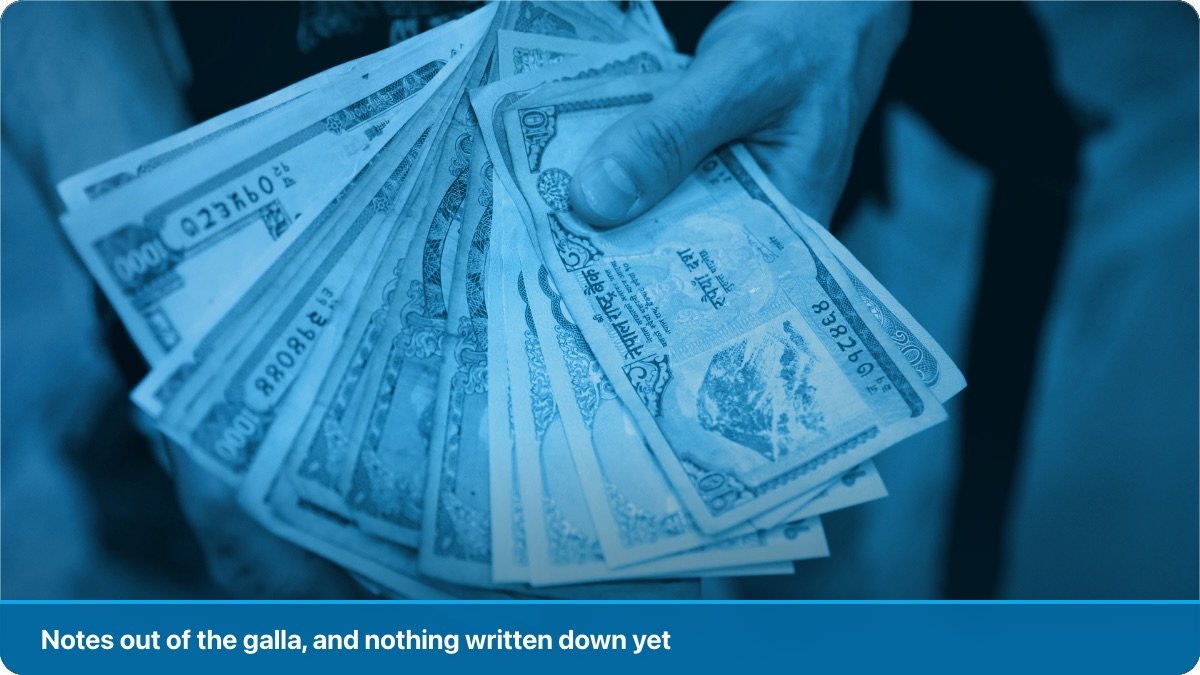
The eggs, the cartons, the cheap sack: you pay for them out of the galla, your cash drawer, and write nothing. Each one is small. They are why the count is short, the margin is a guess, and the month looks better than it was. Two lines at the moment of paying close all four holes.
The purchase that never feels like one
A supplier's delivery comes with a bill, a driver who waits while you check the boxes, and a moment when you sit down and enter it. A crate of eggs from a man on a bicycle has none of that. He stops, you nod, you pay, he pedals off. Thirty seconds, and the shop is as it was, except for one crate and Rs 900.
Say it is 8:20 on a Monday morning at Shakeel's grocery. He is weighing sugar with one hand and holding the bag open with the other when the egg man calls from the road. "Two trays, Rs 900, same as always." Shakeel pulls the notes from the galla with his free hand, passes them over, and the trays slide under the counter. By nine the eggs are on the shelf and the moment is gone.
Nothing about it says "write me down". The sum is small, both hands are busy, and there is no bill to file, so nothing sits on the counter at closing to remind you. A hawker's crate just becomes stock. It felt like a moment, and it was a transaction.
Four holes, one missing line
One unwritten purchase makes four mistakes in four different places, so you rarely see they are the same mistake.
The drawer is short at closing. You count the galla against the day's sales and Rs 900 is missing, with no line anywhere to explain it. So you reach for the only explanation left, which is a person. Your nephew was on the counter at lunch. You start watching people you should trust, over eggs you bought yourself. A daily cash count only works when every note that left has a reason written beside it.
The item has no buying rate. The eggs go on the shelf. What do you charge? Roughly what eggs sell for, so you guess. What they cost you per dozen was never written, so the margin on that crate is unknown, and stays unknown for as long as you buy eggs that way.
Your profit is overstated. Every egg that sells is counted as a sale. The Rs 900 that bought them is counted nowhere. The week's profit figure carries the income and skips the cost, so the month looks better than it was, and you plan against a number that does not exist.
The stock count is wrong the other way. Usually stock goes missing. Here there are eggs on the shelf that came in through no door you recorded, so the count finds more than the book says. Then you stop trusting the count, the worst outcome, because the count is how you catch the real shortages.
What a week of it does to your profit
Say the hawkers and vans bring you five buys in an ordinary week: eggs on Monday for Rs 900, two cartons of biscuits from a van on Tuesday for Rs 1,600, dishcloths from a hawker for Rs 450, a sack of rice on Thursday for Rs 2,200, and bananas on Saturday for Rs 700. All paid from the galla, none written.
One week of buys out of the drawer
Only an example. Put your own week of counter buys into the same lines; the arithmetic does not change.
Rs 5,850 in a week. Your book, which has all the sales and none of these costs, says the week made Rs 14,000. It made Rs 8,150. More than two-fifths of the profit you were counting on was stock you had already paid for.
Run it forward. Rs 5,850 a week is about Rs 23,400 a month and Rs 304,200 across a year. If the book says the shop made Rs 728,000 in twelve months, it made Rs 423,800. The drawer, meanwhile, was telling the truth the whole time: it was short by exactly the amount the book was wrong. You just did not know the two numbers described the same thing.
The item that never had a buying rate
Now cost one of those buys properly.
Say the two cartons hold forty packets. Rs 1,600 divided by forty is Rs 40 a packet. Your shelf price is Rs 50, so the margin is Rs 10 a packet, Rs 400 on the lot, and now you know it.
The two cartons, costed properly
An example, not a real price for any product. Your own figures go in the same lines.
Without the Rs 40 line, watch what happens. The driver said "good rate", so it felt cheap, so you put it out at Rs 45 to move it fast. Your regular supplier charges Rs 42, so the van saved you Rs 80 on the lot. Pricing at Rs 45 gave away Rs 200. You saved Rs 80 and lost Rs 200 in one afternoon, and your accounts will never show you either number.
The buying rate is the one figure that turns a lucky purchase into a known one. Pricing what you sell starts there, and a counter buy gets no exemption for being quick.
Two lines before the notes leave your hand
The fix has to be smaller than the problem or it will not survive a busy counter. It is two lines: what, and how much. "Eggs, 900." "Biscuits 2 ctn, 1600." On anything within reach: a receipt's back, your roznamcha's margin, a message to yourself, the carton itself.
The rule is about timing, not neatness. You write before the notes leave your hand, never at closing time, because by then the purchase is a memory, and memory rounds down. Rs 900 becomes "about eight hundred", the dishcloths vanish, and the rice was "sometime that week". Ask any shopkeeper to recall a week of counter buys and he lands under the true figure every time.
Then, once a day, the slips move into the accounts properly: a purchase with a date, an item, an amount, and a note that it was paid in cash. Five minutes at closing, and all four holes close at once. The drawer has its reasons. The item has its rate. The profit is right. The stock came in through a door.
Say Imran counts the galla of his general store at 9:40 at night and it is Rs 2,300 short. His nephew Bilal was on the counter all afternoon, and Imran is already choosing his words when he finds a torn strip of carton in his shirt pocket: "van, biscuits 2 ctn, 1600. bananas 700." Rs 2,300. He enters two purchases and says nothing to Bilal. The strip cost him eight seconds at four in the afternoon. Without it, the evening would have cost him a nephew's trust.
When the cheap crate is cheap, and when it is not
None of this means stop buying from the van. Some of the best rates a shop ever gets walk in unannounced, and the shopkeeper who never buys from a hawker pays his supplier's full rate for everything, forever.
But a cheap crate is only cheap if it sells. A sack of rice at Rs 2,200 that sits behind the counter for three months has cost you Rs 2,200 the shop needed, plus the space, plus whatever the damp took. Buying out of the drawer on the spot, with no list in your head, is exactly how a shop fills up with stock nobody asked for. The rate was good. The decision was not.
Two questions, before the notes come out.
Do I sell this already, and will it go before the money is needed? If you sold the last of it on Tuesday and it is Thursday, buy. If you have never stocked it and no customer has asked, the rate does not matter.
Why is it cheap? A rate well under your supplier's has a reason. Sometimes it is harmless: he is clearing a van on the way home. Sometimes it is a date two weeks off, a broken seal, a short count in the carton, or goods from somewhere you would rather not know. Look before you pay, not after.
Before the notes leave your hand
Ask both, and the good buys still happen without bringing the bad ones along.
A float, so the count still has a right answer
Set aside a fixed sum for counter buys. Say Rs 5,000 in an envelope or a marked corner of the galla, and these buys come from nowhere else. The main drawer is then for sales and change alone, so its count has a right answer every night, whatever came past the shop.
The float also gives you a second check for free. At closing, Rs 5,000 minus what is left in the envelope is exactly what you bought today, written or not. If Rs 2,700 remains, you spent Rs 2,300; if your slips add up to Rs 1,600, a Rs 700 buy went unwritten, and you can usually name it while the day is fresh.
When the float runs low, top it up from the main drawer with one written line: "float, 3,000." That is cash moving from one place to another, not a purchase, and your accounts should show it that way. Money with a name is money you can count.
Where these buys belong in your accounts
A counter buy is a purchase paid in cash. Your accounts should show exactly that: money leaving the galla, goods arriving on the shelf, an item with a rate.
In Wasoolo the galla is a cash account, and a purchase is money leaving it, with a date and a note. Each product carries its buying rate, so when the eggs come in at Rs 900 for two trays, the margin on every tray you sell is a number, not a feeling. What you bought for the shop itself, the dishcloths and the light bulbs, goes into expenses, and the profit view shows the month with its costs in it.
None of that replaces the strip of carton. Wasoolo is where the slips go at closing, when both hands are free; the strip is what gets them there. Wasoolo is 100% free to download, and the cash account and the buying rate are the first two things worth setting up, because they are the two things a counter buy skips.
Everything above, in five lines
- 1Write two lines before the notes leave your handWhat it was and how much, on anything within reach.
- 2Move the slips into the accounts once a dayAt closing, every slip becomes a purchase with a date.
- 3Give the item its buying rateDivide what you paid by what you got. Now the margin exists.
- 4Buy only from a set floatA known sum set aside, so the drawer count still has a right answer.
- 5Ask two questions firstDo I sell this already, and why is it cheap?
Start your digital khata today
Free to start. Works offline. English, Roman Urdu & Hinglish. Your customers get their app free, forever.
Common questions
I buy from hawkers every day. Do I really have to write every single one?
Yes, and that is why the habit is only two lines: what and how much, on anything, before the notes leave your hand. Ten buys is ten short lines and five minutes at closing. Ten unwritten buys is a drawer short by a figure nobody can explain.
The drawer is short and I have no slips. How do I tell a counter buy from something worse?
Walk the shelves before you accuse anyone. Look for stock fuller than it should be, or an item you do not usually carry, and ask when it arrived. Most short drawers are a crate you paid for and forgot. If the shelves explain nothing, the problem is a different one.
The hawker gives no bill. What do I write as the buying rate?
What you paid divided by what you got. Rs 1,600 for forty packets is Rs 40 a packet. Write that number on the slip and it becomes the rate. A bill is a convenience, not a requirement.
Is buying from the drawer always a bad idea?
No. It goes wrong when the rate makes the decision for you. Ask whether you already sell the item and whether it will go before the money is needed, and ask why it is cheap. If both answers are good, buy it, and write it down.
How big should the float for counter buys be?
Enough for a normal week of the buys you actually make, and no more. Add up a week of slips and round up a little. If the envelope keeps running empty by Wednesday, the float is too small or you are buying too much, and the slips will tell you which.
How does Wasoolo handle a purchase paid in cash?
As money leaving the galla's cash account, with a date and a note. Stock goes against a product with a buying rate, so the margin exists from the day it arrives; what was for the shop itself goes into expenses, and the profit view shows the month with those costs in it.
Not sure how much your counter buys are costing you? Send us a message with a normal week's worth, and we will show you the two lines that catch all of it.