
ProblemStock
When stock goes missing and nobody knows how
The shelf says forty, you count thirty-four, and nobody stole anything. Where small-shop stock really leaks, and the one-shelf count that finds it in a week.
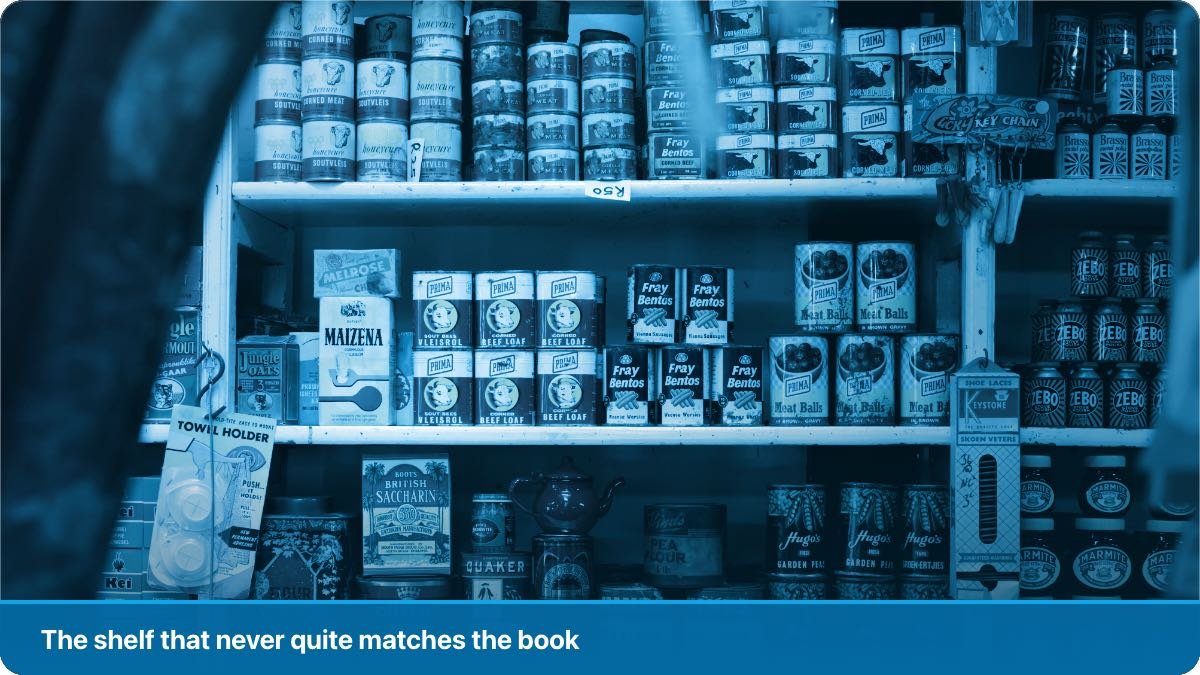
The shelf should hold forty and it holds thirty-four. Nobody stole anything. In most small shops the missing stock left through five small leaks: a short delivery, an unwritten credit sale, a free handful, breakage, and generous weighing. Count one shelf a week and the leak has nowhere to hide.
Six packets missing is not a crime story
The first thought is always the worst one. Somebody is taking it. A helper, a boy who comes in the evening, the man who delivers.
Sometimes that is true. Usually it is not, and starting there costs you twice: you insult somebody who did nothing, and you stop looking for the seven duller reasons that were actually responsible.
Think about what a normal day does to your stock. A sale gets rung up wrong. A packet splits and goes in the bin. A regular customer gets an extra scoop because he is a regular customer. A crate arrives eleven short and gets carried straight to the back without a count. Your own house takes a tin of something and nobody writes it anywhere. Every one of those is small, none of them is dishonest, and by the end of the month they add up to the same figure a thief would have taken.
The way to find them is boring and it works: count small, count often, and always convert the difference into money. A shop that can keep its stock straight is not one with better people in it. It is one that checks a shelf before it opens.
Count one shelf a week, never the whole shop
The one-shelf count: fifteen minutes, not a whole Sunday
- 1Pick one shelf, the one with your fastest sellersNever the whole shop. A whole-shop count happens twice and then never again.
- 2Before opening, count what is physically thereCount the back stock too, not only what the customer can see.
- 3Write the count beside what your book says it should be
- 4Note the difference in pieces, then in what it cost youSix packets is a shrug. Rs 1,100 of your own money is not.
- 5Next week, a different shelf. Come back to this one in a monthFour shelves a month covers a small shop without ever closing it.
Every shopkeeper has tried the full count. It happens on a Sunday, it takes seven hours, it ends in an argument about whether the back room was included, and it never happens again.
One shelf takes fifteen minutes before opening. Pick the shelf with your fastest sellers, because that is where both the money and the mistakes live. Count what is physically there, including the back stock. Write it next to what your book says. Move to a different shelf next week.
Four counts a month covers most of a small shop, and the shop never closes for a minute of it. Better still, a weekly count tells you when the leak started, which a yearly count can never do. If this shelf was right in June and short in July, you have a month to think about instead of a year of guesses.
The second rule is just as important: count before you open, not at the end of the day. At nine in the morning the shelf is still. At eight at night you are tired, customers are still coming, and the number you write down is not a count, it is an estimate.
Missing pieces mean nothing until you price them
Say one shelf is six packets short this week
An example, not a claim about your shop. The point is the second line: a shrug-sized weekly number is a serious yearly one.
Six packets sounds like nothing. Say it out loud in your shop and everybody shrugs.
Now put your own buying price on it. Six packets that cost you Rs 185 each is Rs 1,110 that left the shop this week and returned nothing. Say the same leak runs quietly all year and you are looking at a number bigger than most shopkeepers' monthly earnings, taken from the one part of the business where you had already paid in full.
This is why the buy rate matters more than the sale rate when you are chasing a shortage. Losing stock does not cost you what a customer would have paid. It costs you what you paid, and that money is already gone from your account.
Keeping a cost against every item is what makes this a one-minute calculation instead of a guess. In Wasoolo each product can carry its buy rate, so a shortage can be read in rupees the same evening you find it. However you keep it, keep it, because a shortage nobody has priced is a shortage nobody ever fixes.
Start your digital khata today
Free to start. Works offline. English, Roman Urdu & Hinglish. Your customers get their app free, forever.
The eight places stock actually goes
Where a small shop's stock actually goes
- The delivery was short and nobody counted it at the door
- Sold on credit in a rush and never written into the khata
- The extra handful given free to keep a good customer happy
- Broken, leaked, expired, or eaten by damp in the back
- Taken home for the house and counted as nothing
- Weighed generously, ten grams at a time, all day long
- Returned by a customer and put back without a note
- Actually taken by somebody, which is the last thing to check
Read the list and be honest about which lines are yours. Most shops have two or three that do the real damage, and the owner usually already suspects which.
The unwritten credit sale is the commonest by far. A customer picks up two items during a rush, you nod, you fully intend to write it, and then four people need attention at once. The goods have gone and no line exists anywhere. This is the same crack that makes the cash box disagree with the day's takings, and it is fixed the same way: written at the moment, not at the end of the day.
Free extras are the second. There is nothing wrong with a small extra for a good customer, as long as you know what it costs you in a month. Right now, most shopkeepers do not, because it never gets written anywhere.
Then there is quiet spoilage: the damp corner, the crushed bottom carton, the packet that sat too long. That one overlaps with the stock that never sells, and it grows in exactly the same place, at the back, out of sight.
Most of the shortage arrives short
If you only change one habit, change this one: count the delivery at the door, before the man leaves and before you sign anything.
A short crate is not always dishonesty either. Loaders miscount, orders get part-filled, a substitution gets made at the warehouse and nobody mentions it. But once the vehicle has gone, the shortage is yours, and no supplier is going to accept a phone call the next afternoon about a box he cannot see.
Open it, count it, check the rate against what you ordered, and only then put your name on the paper. It takes four minutes and it removes the single largest hole in a small shop's stock. Write the received quantity into your book the same minute, because a delivery counted properly and then written from memory two hours later is a delivery not counted at all. If you are also buying on credit, this matters twice over, since a short delivery you did not catch becomes a bill you pay in full.
If it really is a person
Sometimes the count keeps pointing at the same shelf, on the same days, and the honest explanations run out.
Do not announce it. A general accusation to everybody insults the people who did nothing and warns the one who did. Instead, narrow it quietly. Count that shelf daily for a week. Note who was on the counter each day. Keep the stock that goes missing where it can be counted easily and, if you can, where it is not the easiest thing in the shop to reach.
When you are sure, deal with it privately and once, with the figure in front of you rather than a speech. Small shops are family businesses and a public scene tends to cost more than the goods did. And if the person is family, the answer is not shouting either: it is a rule that everything leaving the shop is written, whoever takes it, starting with you.
That last part is not a joke. A shopkeeper who takes tea, soap and biscuits home without a line in the book has already made his own count unreliable, and no helper is going to take the rule seriously after that.
The habits that keep a count honest
Start your digital khata today
Free to start. Works offline. English, Roman Urdu & Hinglish. Your customers get their app free, forever.
Write the sale before the customer leaves the counter, cash or credit. That single habit closes the biggest leak on the list.
Count deliveries at the door and enter them the same minute. Keep a small note for breakage and for what your own house takes, and add it to the book weekly, so those pieces stop appearing as mysteries. Weigh the same way every time, because ten free grams a hundred times a day is a real number.
Then count one shelf a week, price the difference, and write it down beside the date. Within two months you will not be guessing about your shortage. You will have a short list of shelves, days and reasons, and most of the reasons will be things you can fix without ever saying a hard word to anybody.
Common questions
How much shortage is normal for a small shop?
There is no honest single figure, and anybody who gives you one is guessing about your shop. What matters is your own trend: measure the same shelf the same way for four weeks and see whether the gap is steady, growing, or tied to particular days. Your own numbers are the only benchmark worth having.
I have hundreds of items. How do I count anything?
You do not count everything, you count what carries the money. Twenty fast-moving items usually hold most of the value in a small shop, so count those weekly and the slow shelves once a quarter. A short list you complete beats a full list you abandon in the third aisle.
My helper says I am accusing him just by counting.
Tell him the truth, which is that counting protects him too. When there is no count, every shortage is a suspicion with nowhere to land, and he is the first person anybody looks at. A shelf checked every week either clears him or finds the real leak, and honest helpers usually work this out quickly.
Should I count at the same time every week?
Yes for the time of day, before opening, so the conditions are the same each week. But do not make the shelf itself predictable if you suspect a person. Same routine, different shelf, is the balance most shopkeepers land on.
Do I count damaged goods as stock?
Take them off the shelf count and put them on a separate damage line the same day. If they stay mixed in, you are hiding a real cost inside a made-up number, and the shortage you eventually chase will be the wrong size. Damage is a cost like power or rent: visible, written, and worth reducing.
The count matches but my profit still looks thin. What now?
Then the leak is not in the stock, it is in the pricing or in the expenses. A shop can hold every packet perfectly and still earn nothing if the rate is set on a cost that is out of date. Once your counts come out clean two months running, move the same attention onto what each item cost you last week versus what you are selling it for today.