
MoneyStock
The stock that never sells, and what it is costing you
Slow goods are not stock, they are your money asleep. A twenty-minute shelf walk, four ways to turn them back into cash, and how to stop buying them.
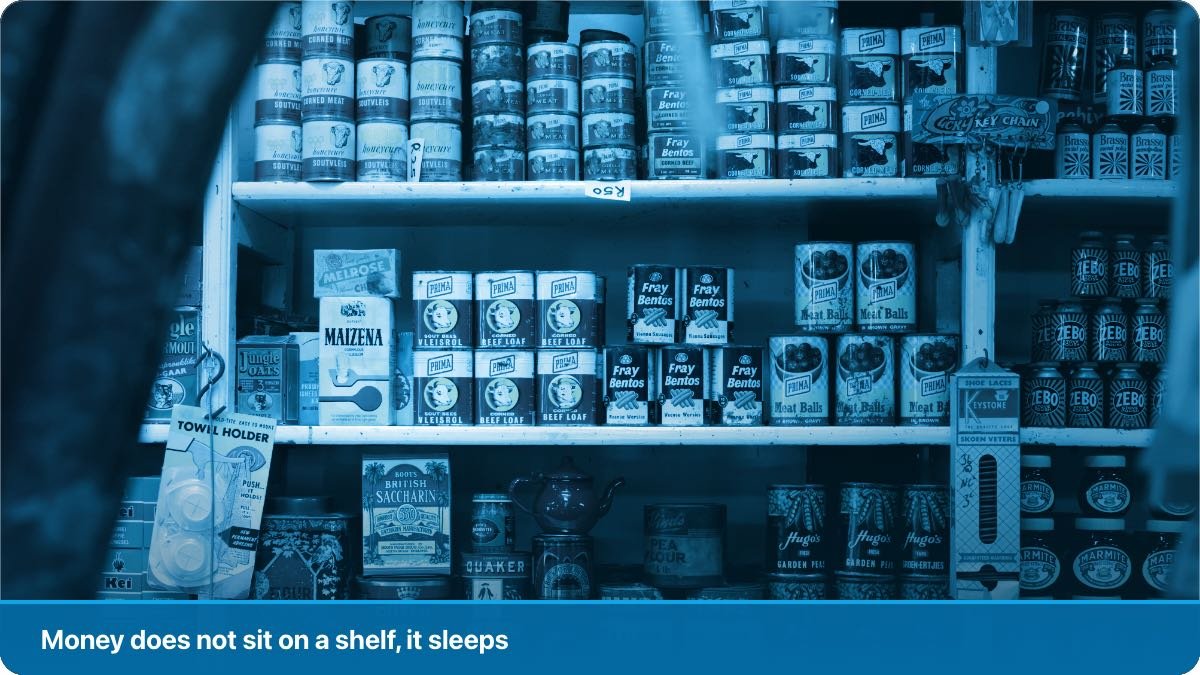
Stock that does not sell is not stock, it is your cash lying down. Find it with one walk around your own shop, work out what it is worth today rather than what you paid, and turn it back into money at that price. Then look honestly at why you bought it.
Money does not sit still on a shelf, it sleeps there
Every shopkeeper knows what a slow item is. Almost none of them know what their slow items are worth added together, and that second number is the one that changes behaviour.
Think about what a box on your top shelf actually is. You paid a supplier real money for it. That money could have been six other things: a case of the soap that empties every week, the payment you owed on Friday, the balance you needed when a good customer asked for a big plan. Instead it is sitting up there, in the dust, being worth slightly less every month.
That is the part people miss. Sleeping stock is not simply not earning. It is quietly losing. Packaging fades, a date passes, a design goes out of fashion, a newer version arrives and makes yours the old one. The longer it waits, the less anybody will pay for it, which means waiting for the right price is usually how the price gets worse.
And it takes up the one thing a small shop has least of, which is space at eye level. Every slow item standing in a good spot is blocking a fast one.
Find it in one walk around your own shop
You do not need a report or a system for the first pass. You need twenty minutes, a slip of paper and your own eyes, because you already know your shop better than any list does.
The twenty-minute walk around your own shelves
- 1Walk before opening or after closingYou need nobody waiting to be served. A slip of paper is the only tool.
- 2Start at the top shelf and the back cornerThat is where slow goods hide, because your eye stopped going there months ago.
- 3Ask one question at every shelfWhen did I last sell one of these? If you cannot remember, that is the answer.
- 4Write the item and roughly how manyNo prices yet, and no explanations about winter. The list comes first.
- 5Add up the buying prices at the endThis one number is what makes the next hour of work actually happen.
- 6Do it once a season, four times a yearIt never becomes a big job again once the first walk is done.
Do the walk before opening or after closing, when nobody needs serving. The question at every shelf is one question, asked out loud if that helps: when did I last sell one of these?
If the honest answer is "I cannot remember", that is the answer. Write the item and roughly how many you have. Do not price it yet and do not start explaining to yourself why it will sell in winter. That comes later, after the list exists.
Most shopkeepers doing this for the first time fill half a page and get a small shock at the end. That shock is useful. It is the same feeling that makes people finally add up what they are owed on credit, and it is what makes the next hour of work actually happen.
What it is worth today, not what you paid
Here is the hardest idea in this whole subject, and everything else depends on accepting it.
What you paid is gone. It went to your supplier months ago and no decision you make today can bring that price back. The only question left is what this thing can turn into now.
Say: what holding out for the old price really costs
Example numbers, not a survey. Put your own slow item in: what you paid, what it fetches today, what it fetched a year ago.
A shopkeeper looks at a Rs 900 item and says he will not sell it for Rs 600 because he paid Rs 700. So it stays on the shelf, where it earns nothing, and next year he will not sell it for Rs 400 for the same reason. He has now spent two years defending a Rs 100 loss and turned it into a Rs 700 loss.
Selling at Rs 600 is not losing Rs 100. It is getting Rs 600 back into the shop, where it can be bought, sold, and bought again several times before that year is out. Cash that moves earns; cash asleep on a shelf does not, however proud the price tag is.
This is exactly the same arithmetic that decides your real profit at the end of the month, and it is the one most people avoid doing.
The four ways to turn it back into cash
Once the list exists, every item on it gets one of four treatments. Not thinking about it is not one of the four.
The four ways out, and what each one costs
Move it, do not discount it. The cheapest fix first. Plenty of slow items are only slow because they are standing in the wrong place. Put it at eye level, at the counter, or beside the thing people actually come in for, and give it two weeks. Some of your list clears here at full price.
Bundle it. Attach it to something that sells by itself. A slow item beside a fast one at a small combined price moves quantity without ever announcing a reduction, and it does not teach customers to wait for your prices to drop.
Cut the price once, clearly, and mean it. Small reductions repeated over months are the worst of both worlds: you lose the money and you also lose the urgency. One clear cut, one week, and the stock is gone.
Return, swap or let it go. Many suppliers will take stock back or exchange it, especially the ones you buy from every week, and especially if you ask early rather than after two years. If nobody will take it and nobody will buy it, give it away with a purchase and take the space back. The space is worth more than the item.
Start your digital khata today
Free to start. Works offline. English, Roman Urdu & Hinglish. Your customers get their app free, forever.
Why it got there in the first place
Clearing the shelf is the easy half. The list you just made is also a list of your own buying habits, and it will repeat itself next year unless you read it.
Look at each item and be honest about which one it was. Somebody talked you into a full carton when you wanted six pieces. It was cheap per unit if you took twenty, and you took twenty. A customer asked for it once, so you ordered a dozen. It sold beautifully for three months, so you bought as though those three months would continue forever.
None of these are stupid. They are all reasonable decisions made with a small amount of information, which is exactly what a shopkeeper has at the moment a supplier is standing in front of him.
The fix is not to be cleverer in that moment. It is to have a written number to check against, so the decision is not made purely on how the offer sounds.
Buying so the next one does not happen
Three habits keep dead stock from rebuilding, and none of them takes more than a minute.
Before you buy, ask how long the last lot took to sell. Not whether it sold, how long. If a dozen took five months, a dozen will take five months again, and a discount for taking twenty-four is not a discount, it is ten months of your cash.
Buy the small quantity of a new item, always, even when the bigger box is cheaper per piece. The cheaper price only exists if the whole box sells. Trying six pieces and running out is a good problem. Trying thirty and keeping twenty-two is the exact problem this article is about.
And write the buying price down where you keep the stock, on the day the goods arrive. When you know what each item cost you, working out what a clearance price really does to your money takes seconds instead of a guess. Wasoolo, which is free to download, keeps a buy rate against every item and shows what your stock is worth at any moment, which is also what makes buying on credit from a supplier safe to do.
What changes in the month after
Two things, and one of them surprises people.
The obvious one is cash. Clearing a shelf of sleeping stock puts money back into the shop at a moment when you did not have to borrow it or wait for a customer to pay. Most shopkeepers immediately spend it on fast-moving goods, which is exactly right.
The one nobody expects is that the shop looks better. A shelf carrying only things people actually buy reads as a busy, well-run shop, and it makes finding anything faster for you and for your customers. Dust on a top shelf sends a message even when nobody is thinking about it.
Do the walk once a season. Twenty minutes, four times a year. It is the shortest job in this article and it is the one that keeps your stock counts honest and your money awake.
Common questions
How long should an item sit before I call it dead stock?
It depends on the item rather than the calendar. For everyday goods that turn over weekly, anything untouched for two months is already slow. For big items that always sold a few times a year, six months is normal and nine is a warning. The useful test is not the date but whether you would buy it again today at the same price.
Should I sell below what I paid?
If nothing else has moved it, yes, and sooner rather than later. Money you paid a supplier last year is already spent, and holding the item does not bring it back. Whatever you get today goes back into stock that turns over several times before the year ends, which is worth far more than protecting a price nobody is paying.
Will a clearance sale teach customers to wait for lower prices?
It can, if reductions are frequent, small and unexplained. Avoid it by cutting once, clearly, and finishing. Bundling is safer still, because the individual price never visibly changes. What genuinely trains customers to wait is a shop that quietly drops prices a little every few weeks and never actually clears anything.
Can I return unsold goods to my supplier?
Often yes, especially with a supplier you buy from regularly, and especially for goods with a date on them. It costs one polite conversation, and the answer improves the earlier you ask. Many shopkeepers never ask at all and carry stock for years that could have gone back or been exchanged in the first month.
How do I know what my stock is worth in total?
Add up what you paid for what is on the shelves right now, not what you would sell it for. That number tells you how much of your money is standing still. If you keep stock on a phone with a buying price against each item, that total is on the screen and updates as goods come in and go out.
I have very little space. Where do I start?
Start with the shelf at eye level and the space nearest the door, because those are the most expensive space in your shop and the easiest to measure. Clear the slow items out of those two places first, even if you only move them to the back. You will usually see the effect on your daily takings within a fortnight.