
CompareCustomers
A discount or a free item: which costs you less?
Taking Rs 100 off and giving something worth Rs 100 are not the same decision. What each really costs, what each teaches, and when to use which.
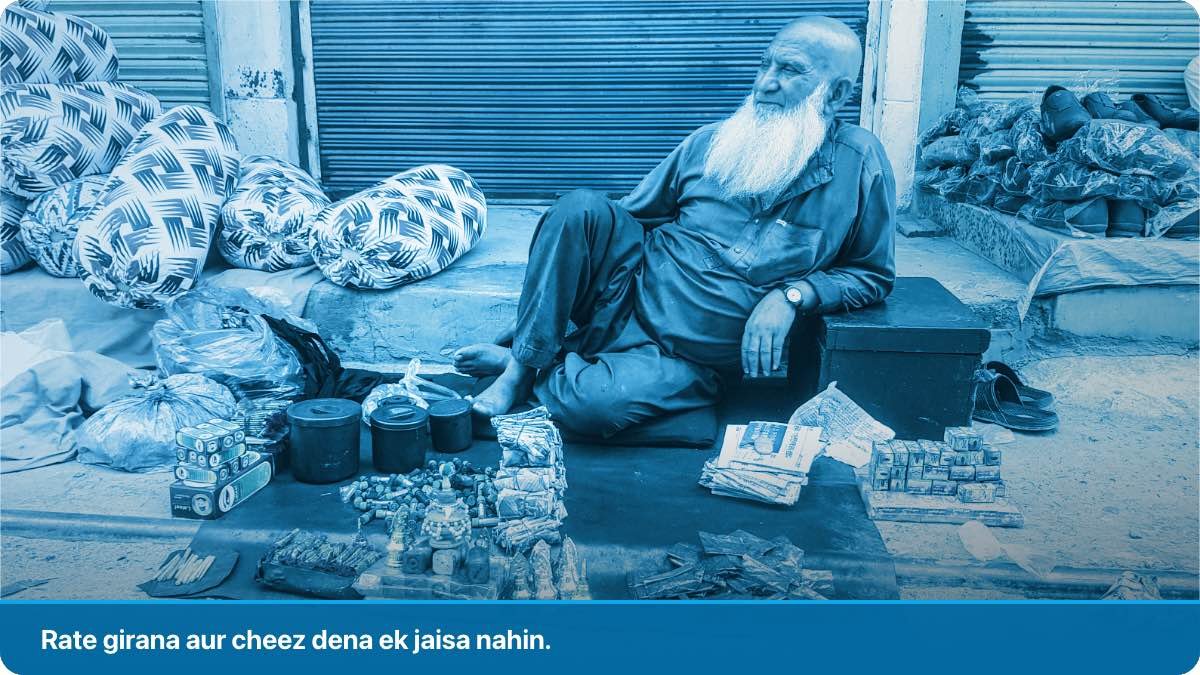
A free item almost always costs you less, because you give up your buying rate instead of your cash, and it does not turn into the customer's new rate. Keep money off the bill for genuinely large orders, full cash payments and old balances you are closing. Use a free item for everything else.
The moment the customer asks
He has picked out about Rs 1,000 of goods, he is standing at the counter, and he says the sentence every shopkeeper hears twenty times a day. Something off, or something extra.
You have about two seconds. Say no and he leaves slightly cooler than he arrived. Say yes and you have just made a decision you will live with for a long time, because whatever you do at this counter today becomes the starting point of the next conversation.
Most shopkeepers treat the two answers as the same thing. Rs 100 off, or something worth Rs 100 in the bag, feels identical. It is not identical, and the difference is not small.
One of them costs you cash and changes your rate permanently. The other costs you your buying price and changes nothing beyond that visit. Understanding which is which is one of the quietly profitable things a shopkeeper can learn.
What each one actually costs you
Put both on one page for a single sale and the gap becomes obvious.
Say a customer buys Rs 1,000 of goods and asks for something
Made-up figures, and the gap depends entirely on your own buying rate. The point is that a discount costs you cash while a free item only costs you what you paid for it.
Rs 100 off the bill costs you exactly Rs 100. There is no other way to read it. The money leaves your margin whole, and if your margin on that sale was Rs 120, you have just given away most of what you earned.
A free item that sells for Rs 100 does not cost you Rs 100. It costs you what you paid for it, which in this example is Rs 72. The rest of that Rs 100 was never money you had; it was margin you were hoping for.
That difference alone, Rs 28 on a single sale, is enough to matter across a year. But the size of it depends completely on your own buying rate, so do the sum with your own numbers before you believe any of it. The method for working out what you actually earn on a sale is in how to work out your shop's real profit.
And there is a second, larger difference that the arithmetic does not show at all.
Side by side
The same Rs 100, two different decisions
Read the second row twice, because it is the one that decides the year rather than the sale.
When you take Rs 100 off, the customer does not experience a gift. He experiences a rate. In his mind, the rate for that basket is now Rs 900, and everything after that is measured against Rs 900. You did not give him a discount. You published a new price, to one person.
When you put something in the bag, he experiences generosity. It belongs to that visit, to that occasion, to something you decided to do. He may hope for it again, and he may even ask, but he does not walk in believing he is owed it.
That is the whole difference, and it explains why a shop that gives things away can hold its rates for years while a shop that gives money off finds its rates sliding downwards without anybody ever deciding to lower them.
Watch two customers on the same afternoon and you can see it happen. The first one gets Rs 100 off a Rs 1,000 basket and says thank you. The second one gets a Rs 100 item put in his bag and says thank you in exactly the same voice. Six weeks later the first one is quoting Rs 900 back at you and the second one is telling somebody that yours is a good shop.
The money you spent was almost the same. What you bought with it was not.
Why a discount is so hard to take back
A rate that has moved once is remembered forever, and by the person with the strongest reason to remember it.
Try to go back to the original figure and you are not raising a price, you are taking something away. Customers accept a new rate on a whole shop calmly and resent a rate that goes up for them personally, because the second one feels like a judgement about them.
It also travels. A man who got Rs 100 off mentions it to a neighbour within a day, not to boast but simply as news. Within a fortnight you have three people asking for the same thing, and two of them will be offended when the answer is no, because it has become a thing your shop does.
And it is hard to defend. A rate you can explain, you can hold. A rate that came from one afternoon of goodwill has no explanation behind it, which leaves you re-negotiating it at every visit. The way to hold a line without an argument is worked through in when every customer asks for a discount.
None of that means a discount is always wrong. It means a discount should be a decision with a reason attached, not a reflex at the counter.
Start your digital khata today
Free to start. Works offline. English, Roman Urdu & Hinglish. Your customers get their app free, forever.
Why a free item can be worse than it looks
The free item is not a trick that costs you nothing, and treating it that way creates its own problems.
The first is habit. If a customer gets something extra on every visit, it stops being a gift and becomes part of the deal, exactly like a discount, only harder to see in your accounts. The cost is buried in your stock rather than sitting on your bill, which means it can run for a year without you noticing.
The second is that it can teach people to ask. A customer who learns that asking produces something will ask every time, and a shop where everybody asks is a tiring shop to run.
The third is the item itself. Giving away something the customer did not want and will not use is not generosity, it is you moving your problem into his bag. He knows what you have done. Give something small, sealed, useful, and plainly worth having, or give nothing.
There is one situation where a free item is unambiguously good business, and it is worth planning for. When you have stock that is slow, near the end of its useful life, or simply sitting in the way, giving it as a gift converts it into goodwill instead of into a loss. That is a far better exit than marking it down, which is one of the options weighed in the stock that never sells and eats your cash.
When to use which
The decision is easier if you make it once, calmly, rather than twenty times a day under pressure.
Give a free item when any of these is true
- You have slow stock you would rather move than store
- It is a one-off occasion, not a regular purchase
- The customer is new and you want him to come back
- You want him to try something he has never bought
- Other customers are standing there and can hear you
- The item is small, sealed and easy to explain
The list at the bottom of that figure is the short version. Money off the bill has three honest uses: a genuinely large order, where the size of the sale pays for it; a full cash payment that closes a balance, where you are buying certainty; and an old account you are settling for good, where a reduction ends a problem rather than starting one.
Everything else should be an item, or nothing.
Notice the fifth line in particular. If other customers are within hearing, an item is much safer than a number. A gift they overhear sounds like the kind of shop you run. A rate they overhear sounds like a rate they should also be getting, and by the time the third person asks, you have set a new price for the whole street.
And whatever you decide, decide it out loud and once. Shopkeepers lose most of their margin not in the giving but in the negotiating, because a hesitant answer invites another round.
The third answer, which is often the best one
There is a third option that costs you nothing at all, and it satisfies more customers than either of the other two.
Give him something that is not money and not stock. Hold an item for him until the next delivery. Tell him when the fresh lot is coming in. Deliver his order to his house. Break a large pack for him. Let him take the goods now and pay on Friday.
Every one of those feels like being looked after, and none of them touches your margin. In many shops the customer asking for something off is not really asking for money at all. He is asking to be treated as somebody who matters, and there are several ways to give him that.
This is also what separates a shop with regulars from a shop with cheap rates. Regulars stay for the treatment, and they are much less price-sensitive than shopkeepers assume, which is the argument made in detail in keeping regular customers and still getting paid.
There is one more version of the third answer that costs nothing and works on almost everybody: attention. Remembering that a man buys the same three things every week, having them ready, and asking after his work is worth more to most customers than Rs 100, and it cannot be copied by a shop that only competes on rates.
Try the third answer first. Reach for an item second. Reach for money last, and only with a reason.
Keeping either one from spreading
Whichever you use, one habit keeps it from turning into a permanent leak.
Write it down. Not in a special book, just as part of the sale: what you gave, to whom, and why. It takes a moment and it makes the yearly total visible, which is the only thing that ever stops this kind of cost from growing quietly.
Set yourself one boundary as well, before the situation arises rather than during it. Decide the largest amount you are willing to give away on an ordinary sale and stick to it, so that the answer at the counter is a habit rather than a calculation done under pressure with a queue behind the customer.
Then look at it once every few months. Almost every shopkeeper who does this for the first time finds that three or four customers are receiving most of what the shop gives away, and that some of them are not the customers he would have chosen. That is a useful thing to know before you set your rates again, which is a job worth doing properly using the approach in how to price what you sell and still earn.
Wasoolo records the sale amount actually charged against the customer's khata, so a lower total is stored as the real figure rather than as a note beside it, and a customer's whole history sits in one place when you want to see what a particular account has really been worth.
Start your digital khata today
Free to start. Works offline. English, Roman Urdu & Hinglish. Your customers get their app free, forever.
Common questions
My customer specifically asks for money off and does not want a free item. What then?
Offer the item first anyway, in a friendly way, and say what it is worth. A surprising number of people accept when the item is something they would have bought. If he genuinely insists on money, decide whether the sale is large enough to pay for it, and if it is not, hold your rate politely and offer him one of the free-of-cost options instead, such as delivery or holding stock for him.
Does giving free items make my shop look cheap?
Not if the item is good and the occasion is clear. What looks cheap is giving away things nobody wants, or giving something every single time so that it becomes a routine. A small, useful, sealed item handed over with a sentence about why is read as generosity rather than as desperation.
How much should a free item be worth compared to the sale?
There is no fixed share, and any number quoted to you is a guess about a different shop. Work it out backwards from your own margin: whatever you give should still leave the sale worth making, and you should be able to say that in one sentence. If handing the item over makes you uneasy, it is too big for that sale.
What about giving a discount to somebody who pays a very old balance in full?
That is one of the three good uses of money off, because you are exchanging a small amount for certainty and for an end to the account. Make the terms explicit and one-time, write the settled figure down, and hand over a receipt showing the account is closed. What you must not do is let that reduction become the standing rate on his future purchases.
Should I advertise the free item or keep it quiet?
For an ordinary counter gift, keep it quiet and personal, because announcing it turns it into an entitlement. For clearing slow stock deliberately, saying it out loud is fine and even helpful, since a stated occasion has a clear end. The rule is that anything you announce should have a finish attached to it.
My competitor down the street gives money off. Am I going to lose customers?
Some, and usually the ones who were only ever going to stay for the rate. Focus on what you can do that a rate cannot buy: keeping the stock people actually ask for, remembering what a customer buys, delivering, and being straight about the account. Customers who leave for a small rate difference tend to come back, and the ones who stay for how they are treated are the ones worth having.