
CompareStock
Behind the counter or on the open shelf?
An open shelf sells more and loses more. Which items earn their freedom, which belong behind you, and the middle arrangement most small shops settle on.
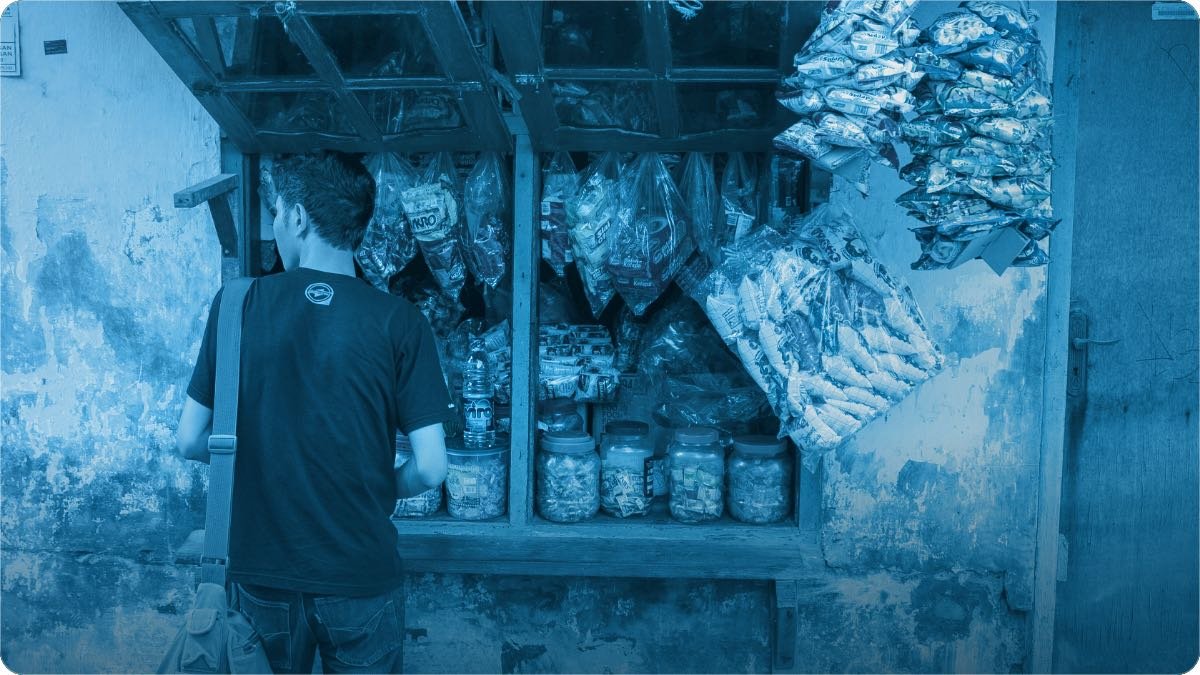
Open the shelves a customer can browse without your hands, and keep behind you anything small, costly, weighed, cut, or easy to lose track of. An open shelf grows the basket and costs you some goods. Decide it item by item, never for the whole shop at once.
Two shops, the same goods, two different days
Walk into one shop and the goods are on shelves you can reach. You pick up a packet, turn it over, put it back, take a different one, and hand three things to the shopkeeper at the end. He barely spoke to you.
Walk into the other and there is a counter between you and everything. You ask for what you want, he turns, finds it, puts it down. You buy the three things you came for and leave. He knew your name and asked after your family.
Both are real shops that work. Both make money. And a shopkeeper who has run one for twenty years and is thinking about becoming the other is usually asking the wrong question, because there is no single answer for a shop. There is an answer for each shelf.
The instinct behind the question is almost always the same: the open shop looks modern and busy, and the shopkeeper feels his own looks old. That instinct is worth taking seriously, and it is also worth separating from the arithmetic, which does not care what a shop looks like.
What an open shelf actually does to sales
The reason open shelves spread is not fashion. It is that people buy more when they can touch things.
A customer who asks for tea gets tea. A customer walking past a shelf of tea sees a new packet, notices a bigger size, remembers he is nearly out of sugar, and picks up something for his children on the way to the counter. None of that happens when the goods are behind you and he has to name each thing out loud.
There is a second effect that shopkeepers underestimate. Asking for something is work, and it is slightly embarrassing work when the shop is busy and other people are waiting. A customer with one small thing in mind will often decide it is not worth interrupting for, and leave without it. An open shelf collects all of those small sales that were never worth asking for.
And there is a third, which is your time. In a shop where everything passes through your hands, you are the limit on how fast the shop can serve. On a busy evening the queue is not caused by the payments; it is caused by the fetching. Open shelves move most of that work to the customer, which matters most in exactly the shops that cannot afford a second pair of hands, a decision weighed in hiring a helper or running the shop alone.
None of this means an open shelf sells more of everything. It sells more of the things people did not come for, and roughly the same amount of the things they did. A shop whose trade is mostly planned purchases, a customer walking in for exactly one item and leaving, gains much less from opening up than a shop where people wander. Watching your own counter for a week and noticing how many baskets have more than three things in them will tell you which sort of shop you are running, and that is the number this whole decision turns on.
What it costs in goods that walk out
The other side is real and it should be stated plainly, without turning it into a complaint about people.
Goods on an open shelf go missing at a higher rate than goods behind a counter. Some of it is taken deliberately. A great deal of it is not: a child picks something up and carries it out while a parent is paying, a packet gets opened and put back, a bottle is knocked behind a rack and found six months later, two items get stuck together and one leaves unpaid.
The size of that loss depends almost entirely on what is on the shelf, and not much on the neighbourhood. Bulky, cheap, everyday things lose almost nothing. Small, expensive, easily pocketed things lose a great deal. A shelf of five-kilo flour bags is safe anywhere. A shelf of razor blades and batteries is not safe anywhere, and treating those two shelves with one policy is the error at the centre of this whole question.
This is the honest part of the missing-stock question, and it deserves a real number rather than a suspicion. Before deciding your shop has a problem with people, it is worth reading when stock goes missing and nobody knows how, because most shops find several ordinary explanations before they find a dishonest one.
It is worth naming the size of it honestly, because shopkeepers tend to imagine one of two extremes. Either the loss is dismissed as nothing, which is how a shelf of small costly items quietly eats a season's margin, or it is imagined as enormous, which is how a shop stays closed off for twenty years and never finds out what the open version would have earned. The truth for most shops is a small, steady, countable amount, and the only way to know yours is to count one shelf.
Say you open one shelf for three months
Say you open one shelf and watch it for three months
A thin win, and it would have been a loss if the goods on that shelf had been small and costly instead.
That result is worth a moment. Rs 750 a month is a win, and it is a thin one. It would very easily have been a loss if the goods on that shelf had been smaller and dearer, and it would have been a much bigger win if the shop had been busy enough that the shopkeeper's freed time turned into more served customers.
Which is the real lesson of the table. The answer is not "open shelves are better" or "counters are safer". The answer is that this particular shelf, with this particular stock, in this particular shop, gained a small amount, and the only way anybody could know that was by trying it on one shelf and counting.
Trying it on one shelf is the whole method. It costs nothing, it takes a season, and it gives you a real number instead of an argument. Most shopkeepers who do it are surprised in one direction or the other, which is a good sign that guessing was never going to work.
Start your digital khata today
Free to start. Works offline. English, Roman Urdu & Hinglish. Your customers get their app free, forever.
The comparison, line by line
The two arrangements, line by line
Two of those rows deserve more than a line.
The one about old stock and expiry dates is the one nobody expects. Customers reaching onto a shelf will take from the front only if the front is what they want; given a choice they reach past the older packet for the fresher one, and the old stock sinks to the back and stays there. Behind a counter you decide which piece leaves, and the oldest goes first without anybody thinking about it. If you open a shelf, somebody now has to face the goods forward and move older stock to the front deliberately, which is a small daily job that quietly prevents the problem described in catching expiry dates before they cost you.
The one about what it says to a customer matters more than shopkeepers think, and it cuts both ways. A younger customer reads an open shelf as a proper shop and a closed counter as somewhere he cannot see what is available. An older regular reads the open shelf as impersonal and misses being served by name. If your trade is mostly people you know, the counter is doing something for you that no shelf can, and giving it up to look modern is a real cost.
The rule that decides each item
Keep it behind the counter if any of these is true
- It is small enough to close a hand around
- One piece is worth more than a day's ordinary sale
- It needs weighing, cutting, measuring or fitting
- It spoils, leaks or is damaged by handling
- Its rate changes often and the sticker cannot keep up
- You would not be able to notice one going missing
That test answers nearly every case in about two seconds, and the useful thing about it is that it produces a short list rather than a policy.
Most shopkeepers who apply it honestly find that the behind-the-counter list is much shorter than they had assumed. Blades, batteries, medicine strips, small phone accessories, cigarettes, perhaps perfume or cosmetics, and anything weighed or cut. Everything else, which is usually the great majority of a shop's lines by value, can face the customer.
The last item on the list is the one worth thinking hardest about, because it is not about the goods at all. If one piece went missing from a shelf, would you notice? On a shelf of ten expensive things, yes, immediately. On a shelf holding forty small packets of many kinds, no, not for months, and the fact that you would not notice is itself the argument for keeping the valuable ones where you can.
There is a related question of pricing. Open shelves need visible, current rates on the goods, because a customer who has to ask the price of everything is being served anyway and you have lost the benefit. Keeping stickers or a board current is a small ongoing job and it is the practical half of how you set your rates.
The middle road most shops settle on
The arrangement most shops settle on
- 1Open the shelves that face you from the counterYour own line of sight is worth more than any lock or barrier.
- 2Put the small costly things at your elbowBlades, batteries, medicine strips, phone accessories, cigarettes.
- 3Give the doorway to whatever pulls people inBulky, cheap, everyday goods that nobody bothers to pocket.
- 4Keep one clear aisle so nobody stands out of sightA shelf you cannot see behind is the same as a shelf outside the shop.
- 5Count the opened shelves more often for a whileWeekly for two months tells you what the change actually cost.
- 6Move any item that keeps disappearing, without dramaIt is a shelf decision, not an accusation about your customers.
The first step there is the one that does most of the work and costs nothing at all.
Your own eyes, from where you actually stand, are worth more than any barrier. A shelf directly in front of the counter is close to as safe as a shelf behind it, and it earns everything an open shelf earns. A shelf around a corner, or behind a tall rack, or in the part of the shop you have to lean out to see, is effectively outside the shop no matter what is on it.
So before moving any goods, stand at your own counter on an ordinary afternoon and look. What can you see without moving? That answer is your open-shelf area, and it may be larger or smaller than you thought. Shops that rearrange the racks so that nothing blocks the view usually gain more than shops that move goods behind the counter.
The last step matters for how the shop feels. When something keeps disappearing, move it, quietly, and say nothing to anybody. A shopkeeper who starts watching customers, or who says something to the street about things going missing, damages the trade far more than the goods were worth. It is a shelf decision. Keep it a shelf decision.
What changes in your record either way
Whichever arrangement you choose, one thing has to change with it: how often you count.
Behind a counter, a shop can go a long time on a rough sense of what is there, because nothing leaves without passing through one pair of hands. Once shelves are open, that sense stops being reliable, and the gap between what your book says and what is on the shelf grows quietly rather than in one visible event.
The answer is not counting everything more often. It is counting the opened shelves more often, and specifically the lines that are small and worth something. Weekly for the first two months after any change, then monthly, and only for those lines. That is twenty minutes a week and it tells you the real cost of the change rather than a feeling about it.
Written buying rates make that counting worth something, because they turn a shortfall into an amount. Wasoolo keeps a buying rate against each product, so when a count comes up short you can write the correction with its reason and see what a quarter of it actually cost, which is the number the decision was always about.
And if a shelf turns out to lose more than it gains, moving those goods back is not a defeat. It is the experiment working. The shops that get this right are not the ones that chose correctly at the start; they are the ones that changed one shelf, counted, and changed another, and let the shop tell them the answer. What to do with the shelves that earn nothing either way is a different question, and it is in the stock that never sells.
Start your digital khata today
Free to start. Works offline. English, Roman Urdu & Hinglish. Your customers get their app free, forever.
My shop is very small. Is an open shelf even possible?
Often yes, for one or two racks facing the counter. In a small shop the customer is standing beside you anyway, which makes an open shelf safer than it would be in a large one.
Should I put up a mirror or a camera?
A mirror that removes a blind corner is cheap and useful. Anything beyond that is a bigger decision, and rearranging the racks so there is no blind corner usually works better.
Customers open packets and put them back. What do I do?
Keep one opened sample of the things people want to inspect, in front, and put the sealed ones behind it. Most of that handling is curiosity, not carelessness.
Will regular customers dislike the change?
Some will, briefly. Keep serving them the way you always did while the shelf exists for everybody else. Nobody is forced to use an open shelf.
How long should I test one shelf before deciding?
Long enough to see an ordinary month or two, and count at both ends. Anything shorter tells you about the novelty rather than the arrangement.
What if I cannot tell whether goods are missing or were never delivered?
Then the problem is at the delivery, not the shelf. Check what arrives against the bill before the van leaves, and the shelf question becomes answerable.