
ProblemUdhaar
The udhaar that has been sitting for a year
A balance that has not moved in a year needs a different plan. Sort your old udhaar by age, chase what is alive, settle what is stuck, close the rest.
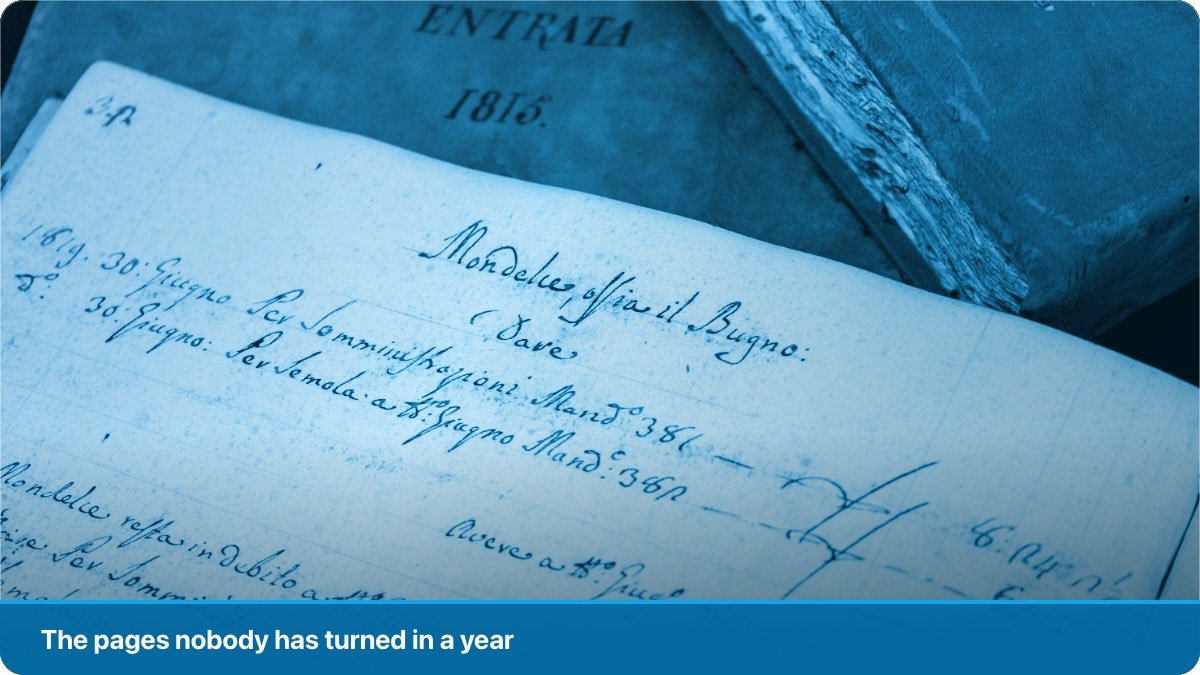
A year-old udhaar is a different job from last month's. The customer has stopped feeling it, and so have you. Sort the list by age, decide which names to chase, which to settle in parts, and which to close. Then fix the rule that let a balance get that old in the first place.
An old balance is not the same problem as a new one
Three weeks of credit and three years of credit look identical on the page. One name, one amount, one line. As a piece of work they have almost nothing in common.
A recent balance still has heat in it. Both of you remember the goods. He knows you know, and he expects the question the next time he walks in, so a single quiet sentence at the counter usually moves it.
A year-old balance has gone cold. He no longer expects to be asked. You have stopped asking, because you asked twice, got a promise both times, and the third ask felt like begging. So the line sits there, and every silent month makes the next sentence harder to say. That is the real reason old lists keep getting older. Not the customer's character, and not your softness. Just the cost of speaking after a long gap.
Which means the old part of your khata needs its own evening and its own plan, separate from the ordinary week of asking for what is owed. Handle it once, properly, and you get a shorter list and a much lighter head.
Sort the list by age, not by amount
One evening's work: putting the old list in order
- 1Write every name that still owes something, with the amountOne page, no order yet. Ten minutes.
- 2Beside each one, write the date of his last paymentNot the date of the sale. The date money last came in.
- 3Sort the page by that date, oldest at the bottomNow the list reads as a story instead of a total.
- 4Draw two lines: under three months, under a year, olderThree piles. Each one gets a different kind of week.
- 5Add up each pile on its own and look at the three numbersMost shopkeepers are surprised by which pile is biggest.
Almost every shopkeeper looks at the biggest number first. It feels right, and it is wrong.
The size of a balance tells you how much you want it back. The age of it tells you how likely it is to come. A Rs 40,000 name who paid something eight weeks ago is in far better health than a Rs 9,000 name who last paid before last winter, and any evening you spend on the two of them should be split accordingly.
So the date you write beside each name is not the date of the sale. It is the date money last came in. That single column changes what you are looking at. A total of Rs 200,000 outstanding says nothing about your shop. The same Rs 200,000 split as Rs 140,000 recent, Rs 40,000 stuck and Rs 20,000 cold is a picture you can act on tonight.
Every entry you write carries its date, so this sort is available in any khata that has been kept honestly. In Wasoolo the last payment on a customer's khata is one tap away, which means the sorting is reading rather than reconstructing. On paper it is an hour with a pen. Either way, do it once and the rest of this article has somewhere to land.
Three piles, three different weeks
The first pile is under three months. This is ordinary trading credit and needs nothing special: the usual reminder, the usual date, the usual counter conversation.
The second pile is three months to a year. These names are stuck, not gone. Something changed at his end, a job, an illness, a bigger repayment somewhere else, and your balance quietly moved to the back of his queue. One real conversation fixes most of this pile. Not a reminder, a conversation: what is possible, by when, in how many parts.
The third pile is over a year old. Be honest about what these are. A few will pay in full when asked properly. Most will pay something if you make it easy. Some will never pay, and a handful have moved on entirely, which is its own kind of problem worth handling separately.
The mistake is treating all three piles the same way. Sending the same message to a five-week balance and a five-year balance wastes your week on the names least likely to move, and teaches the recent ones that your reminders are just noise.
The first call after a long silence
The first call after a long silence
Say this
- Give the exact figure and the date it was last touched
- Ask what he can manage this month, and wait for his answer
- Offer to take it in parts if the whole amount is out of reach
- Fix one date before the call ends and repeat it out loud
Never this
- Open with anger about a year nobody mentioned
- Call his relatives or say it in front of other customers
- Accept a promise with no amount and no date in it
- Add anything on top for the time that has passed
The hardest part of an old balance is the opening sentence, so decide it before you dial.
Start with the fact, not the feeling. The amount and the date. "Bilal, there is Rs 14,000 on your account and the last payment was in October." That is not an accusation, it is a figure, and it gives him nothing to argue with. Then stop talking. The silence after a number is what produces an honest answer, and most shopkeepers fill it themselves out of discomfort.
Then ask what he can manage this month. Not whether he will pay, which invites yes. How much, which invites a number. Whatever he says, even if it is small, take it and fix a date, and repeat the date back so both of you have heard it out loud.
Anger feels satisfying for about four seconds and then costs you the money. A man who has been shouted at in front of others will avoid your shop rather than pay it, and now you have lost both the balance and a customer who was, for years, perfectly good.
Start your digital khata today
Free to start. Works offline. English, Roman Urdu & Hinglish. Your customers get their app free, forever.
Settling for less is not losing
Say a balance of Rs 18,000 has not moved in fourteen months
The numbers are an example, not a promise. Rs 12,000 that arrives beats Rs 18,000 that a page has been carrying for over a year.
This is the part shopkeepers resist most, and it is usually the part that gets the money in.
An old balance is not worth its face value. It is worth what is actually going to arrive. A Rs 18,000 line that has produced nothing in fourteen months has already cost you the goods, and holding out for the full figure has so far returned Rs 0. If he can pay Rs 2,000 a month for six months and you both agree that closes it, you have turned a dead number into real cash in the drawer.
Two conditions make a settlement work. It must be written, with the dates and the closing amount, in a form both of you can see. And it must be final: once he finishes, the account is finished, and nobody brings it up again at a wedding three years later.
Do not offer this at the first ask. Offer it when the ordinary route has failed and the balance is genuinely old. Offering it early teaches every customer that patience earns a discount, which is exactly how a shop full of half-payers gets built.
And keep one line clear in your own head: you are reducing what he owes, not adding anything for the delay. Nothing gets charged on top for time passing. The reduction is a trade, taken because certain money today beats uncertain money forever.
Closing a balance is a decision, not a defeat
Some names will never pay. Pretending otherwise costs you more than the money.
A dead balance that stays in your list does three things. It makes your total look bigger than your shop really is, so you plan on money that is not coming. It sits in your head every time you see the name. And it quietly stops you from working the names that would actually pay.
So close it deliberately. Write the date, write what you decided, and take it out of the live total. This is not forgiveness and it is not a gift, it is bookkeeping catching up with the truth. Keep the record itself. Wasoolo keeps a closed khata and its history in the record rather than erasing it, which matters on the day the man reappears wanting goods, because you can open the page and see exactly how the last one ended.
Then let it go. A shopkeeper who has closed four hopeless lines and written the reason beside each one runs a cleaner business than one carrying eleven years of imaginary assets.
Start your digital khata today
Free to start. Works offline. English, Roman Urdu & Hinglish. Your customers get their app free, forever.
Make next year's old list shorter
Every year-old balance was once a fresh one that nobody chased in month two. That is the only lesson worth taking from this evening.
Three habits keep the list short. Write a date at the moment credit is given, out loud, so the customer hears it. Look at your oldest five names once a month, on a fixed day, before they become your oldest twenty. And put a ceiling on what one name may carry, because a balance that never had a limit is the one that goes quiet, and deciding that number in advance is far easier than deciding it after the goods have left the shop.
Do this and the old pile stops refilling. Your list stays a working tool instead of a museum of things that went wrong, and the money that used to sit on those pages sits in your stock instead, where it can earn something.
Common questions
How long should I wait before calling an old balance a bad one?
Twelve months with nothing at all coming in is a fair line for most small shops, and six is fair if he still lives nearby and still shops elsewhere. The date that matters is the last payment, not the last promise. A man who paid Rs 500 in June is a different case from a man who has said "next week" since June.
Should I stop giving him goods while the old amount is unpaid?
Cash yes, more credit no. Refusing to serve him at all removes your only regular contact with him, and a customer who still walks in is a customer you can still talk to. Sell for cash, keep the relationship, and let the old line come down in parts.
He says he will pay when his own money comes in. Do I believe him?
Believe him and still fix a date. "When my payment comes" has no day in it, so it can never be missed, which is exactly why people say it. Ask which week he expects it, write that week down, and call the day after. You are not doubting him, you are giving the promise a shape.
Is it worth going to his house for an old balance?
For a large one, yes, once, calmly and alone, in daylight. Not with a group, not at night, and never with the neighbours watching. The visit works because it shows the matter is not forgotten, and it stops working the moment it becomes a scene, because then he owes you money and holds a grudge.
Should I tell other shopkeepers about him?
Warning a friend honestly when he asks is normal trade. Going around telling everybody is not, and in a small market it usually comes back to you as a reputation for being hard, which costs more custom than the balance was worth. Keep your own record instead, and let it decide what you give next time.
I have hundreds of old names. Where do I even start?
Take the twenty largest from the year-old pile and nothing else. Twenty is one week of calls at four a day. Finish those, write what happened beside each, and only then take the next twenty. A list you actually finish beats a plan for all three hundred that dies on the second evening.