
ProblemUdhaar
How much udhaar to give one customer, and who should get it
Decide the number before he asks. A weekly limit for every customer, how to say it out loud without a fight, and the monthly check that keeps udhaar honest.
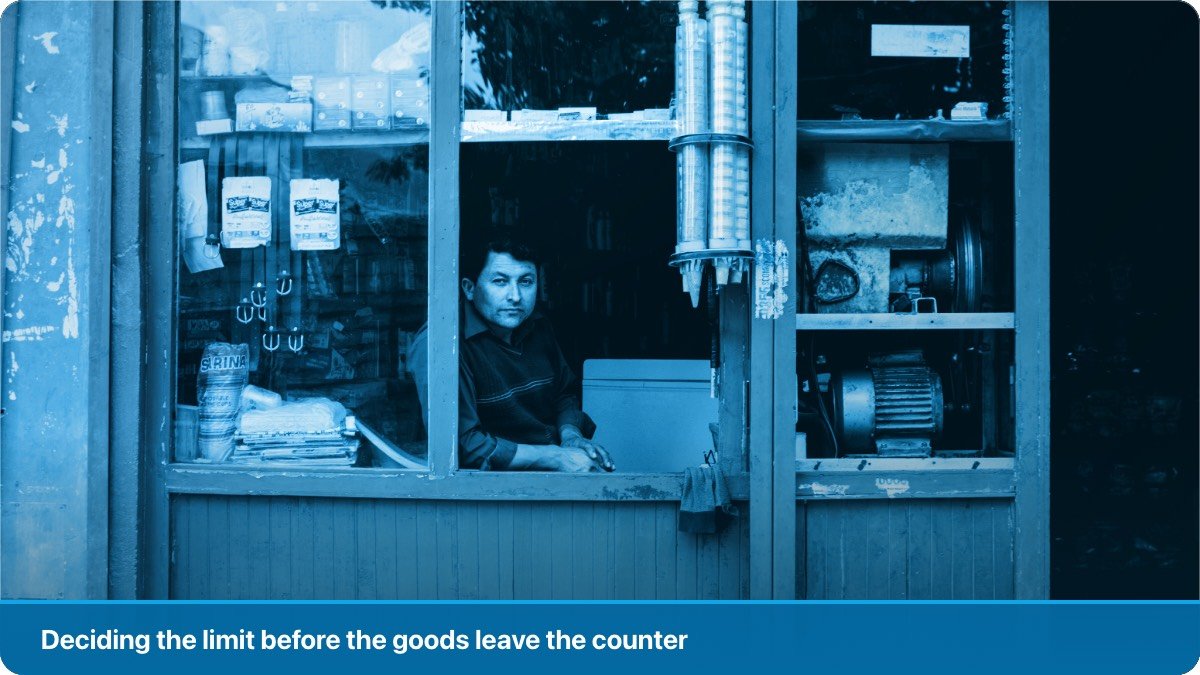
Decide the number before he asks, not after. For most small shops a safe limit is about one week of that customer's normal buying, and nothing new leaves the counter until the old balance comes down. Set it quietly, say it out loud once, and look at the whole list every month.
The number you never set is the number that hurts
Ask a shopkeeper how much udhaar he gives and you get a shrug. Ask how much one particular customer owes and you get an exact figure, usually to the rupee, usually with a small sigh.
That gap is the whole problem. The amount is always known afterwards and almost never decided beforehand. Nobody sits down on a Monday morning and says "Rasheed can take up to Rs 5,000 and not one rupee further". He takes two hundred, then four hundred, then a full bag of flour before a wedding, and one evening you are looking at Rs 9,400 beside a man who buys Rs 300 of goods a week.
Nothing dishonest happened. He did not plan it and neither did you. The number simply grew because there was no number.
A limit is not a wall against your customers. It is one decision, made calmly in the morning, instead of thirty small decisions made badly at six in the evening with four people waiting and the phone ringing.
Three questions before a new face gets credit
Somebody you have never served asks for goods on credit. You have about ten seconds, and saying yes without thinking is how most bad balances begin.
Where does he live or work? Not the exact address. A street, a workshop, a school, a bus stand. A man whose place you can name is a man you can find. A man who says "just nearby" and looks away is a man you will be describing to your friends later, badly.
Who else knows him? In a bazaar this costs one question to the shop next door. If nobody in the whole row has heard of him, that proves nothing on its own, but it does mean tonight is not the night for Rs 3,000 of goods on credit.
Does he need it, or does he just not feel like paying today? A daily wage man who is short on Thursday and paid on Friday is a good customer for years. A man with cash in his pocket who simply prefers to keep it there is teaching your shop a habit you will not enjoy.
For the first month: cash, or a very small amount. Not as a punishment. It is what a bank does with two weeks of paperwork, done in your head in ten seconds.
A limit any shop can work out in a minute
Here is the whole method, and it fits on the back of a receipt. Take what that customer normally buys in a week. That is his limit. Round it up to a number you can say out loud without doing arithmetic.
Say: working out one customer's limit
Example numbers, not a survey. Put in your own customer: one normal day, times seven, rounded up.
One week, because that is how most people are paid. A man paid monthly can carry a month of buying once he has cleared his balance a dozen times. A man you met in March gets one week and nothing more until he has cleared it twice.
The number is allowed to move. It should move. A customer who clears his balance every single month has earned a bigger limit, and giving it to him is how a shop grows loyalty that nobody can buy away from you. A customer who takes four months to pay Rs 2,000 has earned a smaller one, and pretending otherwise is not kindness.
What must never happen is the limit moving because it is late in the evening and you are tired of arguing.
Say it out loud, once, before it matters
A limit kept secret in your head does nothing. He walks in, asks for goods, and you either hand them over or refuse for reasons he has never heard before. That is where a good customer turns into an offended one.
So say it early, on a calm day, when he owes little or nothing.
"Adnan, I keep about Rs 2,000 running for everybody. Once you cross it, we clear it first and then carry on."
Notice what that sentence does. It is a shop rule, not a verdict on his character. It applies to everybody, so nobody is singled out. And it arrives before he is standing there with a bag in his hand and three people behind him, which is the moment when a refusal feels personal.
Saying the limit so nobody is offended
This works
- Say it on a calm day, while he owes little or nothing
- Give it as a shop rule that applies to everybody
- Turn the screen or the page so he reads the balance himself
- Offer part cash and part credit so he never leaves empty handed
- Repeat the same number the next three times it is tested
This starts a fight
- Announce his balance in front of the other customers
- Change the number because the evening got busy
- Say anything about people like him
- Let it slide four times, then refuse on the fifth
- Explain the refusal as something wrong with him
At seven in the evening, Bilal wants a Rs 900 gas cylinder and already owes Rs 1,800 against a Rs 2,000 limit. You do not refuse him. You say the balance out loud, take Rs 700 in cash now, and put Rs 200 on the khata. He leaves with the cylinder, you leave with your limit intact, and nothing was said that either of you has to apologise for tomorrow.
Start your digital khata today
Free to start. Works offline. English, Roman Urdu & Hinglish. Your customers get their app free, forever.
What to do when a good customer goes over
Sooner or later somebody you like and trust crosses the line. A hospital week, a wedding, a bad month. Refusing flatly would be both cruel and stupid, because this is the customer who has paid you fifty times.
Deal with it as a plan, not as a decision at the counter. Three sentences: how much, by when, and what happens meanwhile.
"Take it. Rs 3,500 now puts you at Rs 6,000. Give me Rs 2,000 on the tenth and Rs 2,000 on the twenty-fifth, and we go back to normal after that."
Then write the two dates down where you will actually see them, because a promise you do not record is a promise both of you will remember differently. If your khata is on your phone, put the dates in it and let the reminder come to you. If it is a register, one line on the front page beats a good memory every time.
The one thing not to do is let it sit silently and grow, then explode about it in the fourth month. A balance that got there slowly with your permission cannot be blamed on him alone, and both of you will know it.
The monthly look that keeps the list honest
A limit is a rule for one customer. This is the rule for the whole shop, and it takes twenty minutes on the same date every month.
The twenty minutes that keep the whole list honest
- 1Pick one date and keep itThe first of the month, or the day after your own supplier is paid.
- 2Add up the whole thing onceThe total is the number that changes how freely next month goes out.
- 3Mark everyone above his own limitNot the big balances. The ones bigger than what that person was allowed.
- 4Mark everyone silent for thirty daysNo purchase and no payment. These are the ones that quietly go bad.
- 5Write one line of plan per marked nameHow much, by when. Two words each, not a speech.
- 6Move two limitsUp for whoever cleared twice, down for whoever took four months.
Two things come out of those twenty minutes. First, the total, which surprises most shopkeepers the first time they add it up and quietly changes how freely the next month goes out. Second, the quiet ones: not the loud defaulters you already think about, but the man who has bought nothing and paid nothing for six weeks and has slipped out of your mind completely.
If you keep your khata on paper, do this with a pen and a cup of tea on the first of the month. If it is on a phone, sorting by balance and by last payment date takes a few seconds, and the total you are owed is on the screen whether you asked for it or not. Wasoolo is free to download and shows both without any adding up.
Saying no without making an enemy
Some refusals are unavoidable. The trick is that the customer must leave feeling the rule refused him, not you.
Give a reason that is about the shop. "My own supplier's payment is due on the fifth, so I am short this week" is true in almost every small shop and impossible to argue with. Never give a reason about him personally, and never say anything about people like him. That sentence outlives the argument by ten years.
Offer half. A man who wanted Rs 1,500 of goods and walks out with Rs 700 of goods for cash and a clear balance is not an enemy. A man who walks out with nothing at all, in front of others, is telling that story at the next shop within the hour.
And leave the door open with a date. "Clear this by Friday and we start again fresh on Saturday" turns a refusal into a plan. It also does something a flat no never does: it gives him a reason to come back, which is the entire point of keeping a regular customer rather than winning one evening.
The last part is the hardest and it is not about money at all. A shopkeeper who never refuses is not generous, he is simply postponing an unpleasant conversation until it has become an expensive one. The kindest limit is the one said early, in a normal voice, to somebody who still owes you nothing.
Common questions
How much udhaar should I give a brand new customer?
For the first month, either nothing or a very small amount, around one day of ordinary buying. Let him clear it twice before you raise it. Almost every large loss in a small shop started as a large first amount given to somebody nobody in the bazaar could name, on an evening when the shopkeeper did not want to seem unfriendly.
My limit keeps getting broken. What am I doing wrong?
Usually one of two things. Either the limit was never said out loud, so the customer has no idea it exists, or it moves whenever the evening gets busy. A number that changes with your mood is not a limit, it is a hope. Hold it the first three times it is tested and after that it holds itself.
Should the limit be the same for everybody?
One starting number for everybody is easier to say and easier to defend, because nobody feels singled out. After that it should move with behaviour: up for a customer who clears every month, down for one who takes four months to pay a small amount. What it should never move with is who somebody's relatives are.
A customer got angry when I mentioned his balance. What now?
Anger at a balance is almost always embarrassment, not dishonesty. Lower your voice, move away from the other customers, and put the number in front of him rather than saying it at him. Then ask what he can manage this week instead of what he owes in total.
Is it rude to refuse credit to an old customer?
It is far ruder to keep saying yes silently and then treat him coldly for a year. Old customers can hear a rule; what they cannot forgive is being embarrassed in front of others or being surprised by a refusal that had clearly been building for months. Give the reason, give the date, and keep serving him for cash meanwhile.
Do I need an app to run limits, or is a register enough?
A register is enough if you can add up the whole list once a month without giving up, which is realistic up to roughly twenty or thirty credit customers. Past that, the adding up is what stops happening, and a limit you cannot see is a limit that does not exist.