
MoneyCustomers
The customer who costs you more than he brings
Some customers earn you less than the time, discounts and chasing they take. Here is how to count it honestly, fix it first, and let go without a scene.
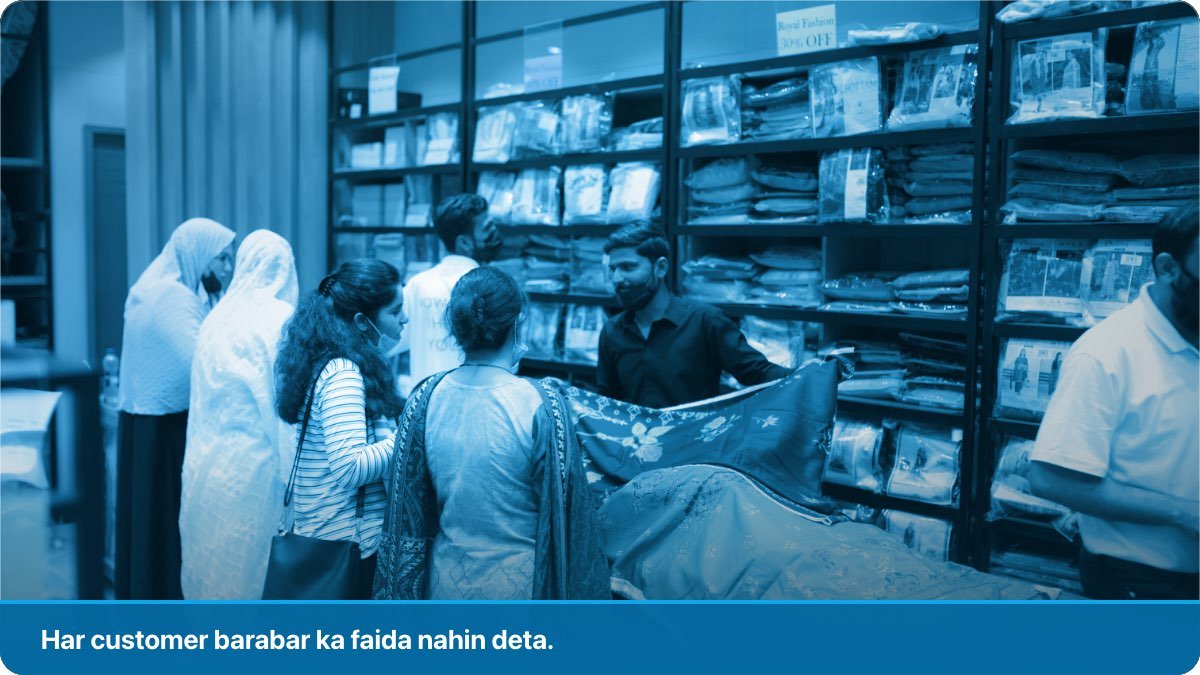
Count what he actually leaves you: margin, minus the discount he always gets, minus returns, minus the trips you make to collect. If four of the six signs are present and a plain conversation does not change them, settle the old balance, move him to cash, and keep serving him politely. Nobody has to be told anything.
The customer everybody in the shop knows
Every shop has one. He comes in three or four times a week, he buys a fair amount, and by the time he leaves you feel tired.
He wants the rate checked. He wants a little off. He takes something and brings it back. His balance never quite closes, and twice a month you find yourself walking to his street with your book in your hand.
Ask any shopkeeper who it is and he will name the man in two seconds. Ask him whether that customer is profitable and he will not know, because nobody ever counts it.
That gap is the whole subject. The feeling that somebody is hard work is not evidence, and plenty of demanding customers are excellent business. But sometimes the feeling is right, and the only way to tell is to put numbers on it once.
Count what he actually brings you
Do this for one customer, on one page, for one month. It takes fifteen minutes and you only ever need to do it properly once.
Say a customer buys Rs 4,000 a month from you
Made-up figures to show the shape of the sum. Do it with your own margin, your own discounts and your own trips before you decide anything about a real person.
The important line is the second-last one, and shopkeepers almost never include it. Two collection trips a month are not free. They cost fuel, they cost an hour each, and that hour was taken from your own shop, which was either closed or being run by somebody else while you were out.
The last line is worse. Rs 9,000 of your money has been sitting with him for four months. That is stock you could not buy, a supplier you paid late, or a rent you covered from somewhere else.
Now look at what the month leaves: Rs 90. He is not a bad man and he is not stealing from you. He is simply a customer whose habits have quietly eaten everything you earn from him.
Do the same sum for one of your ordinary customers, and the difference will surprise you more than the number itself.
The six signs
One month is a snapshot, and a snapshot can be unfair. Before you conclude anything, look back over a longer stretch and ask whether the same month keeps repeating. The arithmetic tells you the answer for one month. The signs tell you whether it is a pattern.
Six signs, and it takes four of them to matter
- His balance has not gone down in months, only sideways
- Every purchase comes with a request for a discount
- He argues about the rate or the total most visits
- He returns or exchanges more than anyone else
- You go to him for money more than twice a month
- Serving him costs you other customers standing behind
Be honest about the threshold. One or two of these describe a normal customer having a difficult few months, and that person deserves patience rather than a decision. Four together describe a habit, and a habit that has survived a year of your patience will survive another one.
Notice that none of the six is about how much he spends. A customer who buys a great deal and pays slowly can be worth keeping, while one who buys a little and argues about everything usually is not, which cuts across the assumption examined in one big buyer or twenty small ones.
Also notice that being unpleasant is not on the list. Plenty of blunt, difficult people pay on time and buy well. Rudeness is annoying; unpaid balances and unpaid hours are what actually cost money.
Start your digital khata today
Free to start. Works offline. English, Roman Urdu & Hinglish. Your customers get their app free, forever.
Fix it before you end it
Most of these customers can be repaired, and repairing one is far more profitable than replacing him.
Deal with the discount first, because it is the easiest. Set your rate, say it once in a normal voice, and stop moving. A customer who has been given something off for two years will test you twice and then accept it, and the method for holding that line without a fight is set out in when every customer asks for a discount.
Then deal with the balance. Give him a limit and say it out loud: the khata runs to a stated figure, and above that it is cash until it comes down. This is not a punishment, it is the ordinary discipline described in how much udhaar to give and to whom, and most customers accept a limit immediately because it is a rule rather than an opinion about them.
Then stop the trips. Instead of going to his street twice a month, tell him the day you collect and ask him to come in on it. Many of these customers are not avoiding you at all; they simply learned that you will come, and people naturally stop doing what somebody else does for them.
Give this two or three months. A genuine number of these customers turn into your steadiest ones, because what they needed was not more patience but a clear line.
Three ways to let a customer go
If nothing changes, end it properly. There is a right order, and it matters.
Ending it without a scene, in order
- 1Settle the old balance first, even at a discountNever close credit while he still owes you; that guarantees you never get it.
- 2Move him to cash, quietly and without a reason"The khata is closed for now" is enough. Explanations invite negotiation.
- 3Keep serving him properlyHe is still a customer. Cash buyers who feel respected come back and pay.
- 4Say nothing about him to anyone elseOne story told at the counter costs you more customers than he ever did.
The first step is the one people get wrong most often. Never close a customer's credit while he still owes you a large balance, because the moment he has nothing to gain from your shop he has no reason to pay you at all. Settle first, even if settling means accepting a little less than the full amount, and only then change the terms.
The second step is a sentence, not a speech. "The khata is closed for now" needs no explanation, and any explanation you offer becomes something to argue with. A shopkeeper who lists reasons is a shopkeeper who will be negotiating for twenty minutes.
The third step is the one that protects you. Keep serving him well. He is still a paying customer at your counter, and a man who was moved to cash but treated with respect will keep buying, keep quiet, and often clear his old balance out of embarrassment.
And say nothing about him to anybody. A story told at your counter travels the whole street within a day, and it does not sound like a warning about him, it sounds like a warning about you.
The customers who look expensive but are not
Before you decide about anyone, check that you are not about to lose one of these.
The customer who buys little but sends people. Some of your best business arrives because a man in a workshop tells five others where to shop. His own account looks unimpressive and his real value is on somebody else's page.
The seasonal buyer. Someone who is a nuisance for months and then places one large order is not a bad customer, he is an uneven one, and judging him on a slow stretch is a mistake.
The one going through a bad period. A customer of six years who has become difficult over the last few months is a customer with a problem, not a customer with a habit. The right response there is the one in keeping regular customers and still getting paid, not a closed khata.
The test is simple. Ask whether he has always been like this. If the answer is no, fix the situation. If the answer is yes, you are dealing with who he is.
What to do with the space he leaves
There is a quiet benefit that shopkeepers do not expect, and it is bigger than the money.
You get your time back. The hours spent on collection trips, arguments and returns go somewhere else: to the customers standing behind him, to the stock that needed ordering, to the shop closing at a sane hour. In a small shop the owner's attention is the scarcest thing in the building.
It is worth saying plainly that this almost never means an argument. In practice a customer moved to cash keeps coming, buys slightly less, complains for a fortnight and then stops noticing. The confrontation shopkeepers dread is mostly imagined, and the dread itself is what keeps a bad account running for years.
You also get the cash back. A balance that has been stuck for months, once settled, becomes stock, and stock becomes sales. That is a real return on a decision that felt purely negative when you made it.
And you find out something useful. Once you have done this arithmetic for one customer, you will do it in your head for everybody, and you will notice which of your accounts are genuinely earning. Keeping every balance, every payment and every date in one place is what makes that possible without an evening of work; Wasoolo shows each customer's account and how long money has been sitting there, so the quiet drain is visible before it costs you a year.
Start your digital khata today
Free to start. Works offline. English, Roman Urdu & Hinglish. Your customers get their app free, forever.
Common questions
Is it wrong to stop giving credit to somebody who has bought from me for years?
It is not wrong, but the order matters and the manner matters more. Settle what is owed first, change the terms quietly without a lecture, and keep serving him exactly as well as before. Years of business earn a customer courtesy and honesty; they do not oblige you to keep funding a balance that never moves.
He owes me a lot. If I close his khata, will I ever see that money?
Almost certainly not, which is why closing credit is always the last step and never the first. Agree a settlement while he still has a reason to keep your shop open to him, even if you accept a little less to end it. Only after the balance is cleared or a written plan is running should the terms change.
How do I say no to the discount without losing him?
Say the rate once, in an ordinary voice, and then stop talking. Most of the pressure in these moments comes from the shopkeeper filling the silence with justifications. Offer something that costs you nothing instead, such as holding an item for him or telling him when a fresh delivery lands, and the refusal stops feeling personal.
What if he is a relative or a neighbour I cannot avoid?
Then the fix is a rule rather than a decision about him, because a rule is much easier to say and much harder to argue with. Set a limit that applies to the whole khata and mention it before the situation is tense. Family credit has its own pressures and its own way out, and those are worked through in when family and friends ask you for udhaar.
Should I tell him why I am closing his credit?
No, beyond a short and true sentence. Detailed reasons invite a negotiation about each one, and they usually end with you agreeing to a trial that repeats the whole cycle. "The khata is closed for now" is complete, and it leaves the door open if his situation changes later.
How many customers like this does a normal shop have?
Nobody can tell you a number, and any figure quoted at you is somebody's guess. What is worth knowing is your own: work out the true cost for the three customers who tire you most, and you will know within an evening whether you have a real problem or an irritation. Most shopkeepers find it is one or two people, not a category.