
MoneyStock
Pricing the one item only your shop keeps
Nobody else in the bazaar stocks it, so nobody can quote against you. How to set that rate so it earns properly without teaching people to shop elsewhere.
Set the rate on what the item really costs you to keep: the trip, the pack you were forced to buy, the pieces that spoil, and the months your money sits in it. Then hold that rate and never move it. You are pricing the wait, not the fact that he has nowhere else to go.
The two ways this rate goes wrong
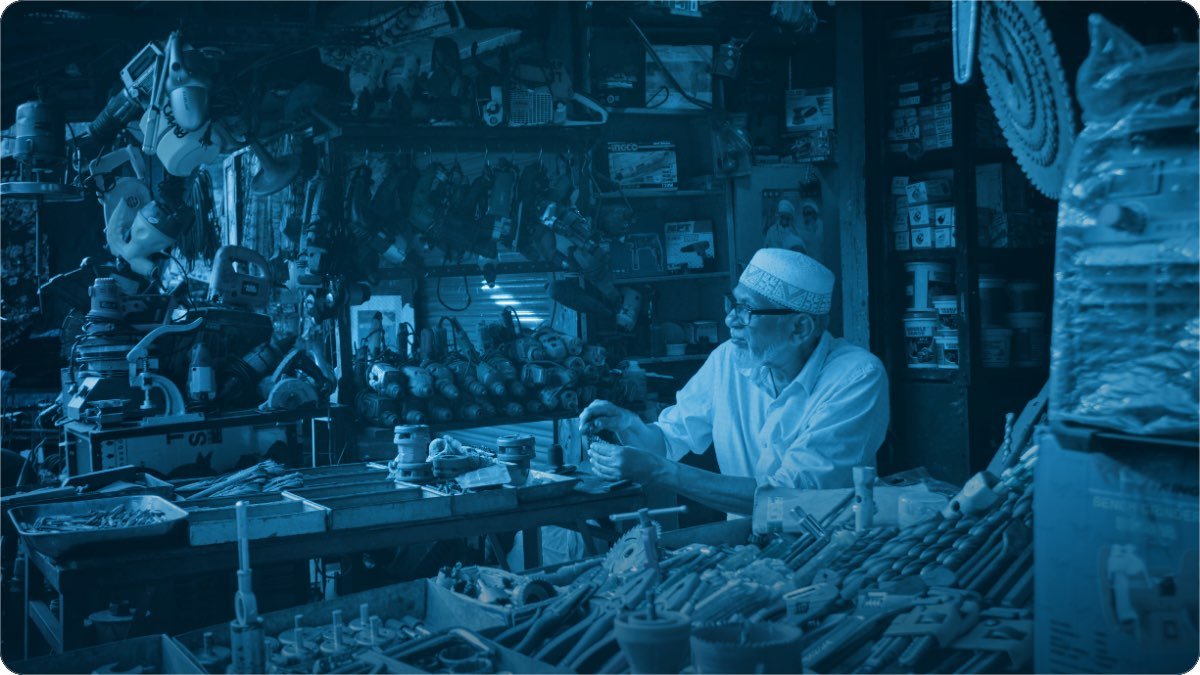
Rashid runs a hardware dukan on a busy street. He is the only shopkeeper on it who keeps a heavy brass float valve for water tanks. Everyone else keeps the plastic one, because the plastic one moves.
Eleven in the morning. A plumber called Adnan asks for the brass valve. Rashid digs it out of a box at the back, blows the dust off it, and says, "Three hundred and eighty." That is his usual markup on taps and fittings, so it is the number that comes out of his mouth. Adnan pays and goes.
That is the common mistake. He priced a valve that sat for eleven months exactly like a tap that sells four times a day. He forgot the trip, the box of twelve he had to take, and the money asleep in that box. Nothing about the sale felt wrong. It still lost him money.
The other mistake is louder. A plumber turns up at eight at night, stuck on a job, and the shopkeeper reads the situation and says nine hundred. The man pays, because he has to. He also stops buying his cement, his tape and his washers there. You did not lose one valve's earning. You lost a basket, every week, for years. That is why setting a rate deliberately matters most on the item where nobody can correct you.
What it cost you to have it on the shelf
The invoice is not the cost. It is one line of the cost, and on a slow item it is the smallest line.
Say you were made to buy a case of 12 and you sell three a year
Look at the last two numbers in that box, because the whole article lives in the gap between them. The valve cost Rs 340 on the bill. It cost Rs 438 for every one you actually put in a customer's hand. Rashid's Rs 380 was not a thin profit. It was a loss of Rs 58 a piece, repeated for four years.
Three things did that. The trip is real money, and on a small order it lands heavily per piece. The pack size was not your choice, so the pieces you did not want are part of the price of the ones you did. And storage is not free: things fade, rust, get crushed under a heavier box.
None of this shows up anywhere. Your shelf looks fine. Your sale looks fine. This is the same quiet arithmetic that turns stock that never sells into a hole in your cash, except here you also get to feel clever about being the only shop that has it.
Price the wait, not the fact that he has nowhere to go
There is an honest reason this item should earn more per piece than the ones beside it, and there is a dishonest one. Keep them separate in your own head, because your customer can tell the difference even when he cannot prove it.
The honest reason is time. Your Rs 4,380 is parked. In your fast lines that same money turns over again and again, earning a little each time. In this box it earns once every few years. A rate that pays you for the parking is fair, and you can say it out loud to anybody without embarrassment.
The dishonest reason is his situation. He needs it today, the next shop is far, and you can see it on his face. Pricing that is not business. It is a one-time collection, and the bill arrives later as a customer who now drives past you.
The same slow item, priced two ways
Speed changes everything about this number, which is why the same rate is generous in one shop and thin in another.
Same Rs 520 rate, three different speeds: what the case hands back in a year
Only an example, never a claim about any real shop. The rate never changed. Only the speed did, and the speed is what decides whether the shelf space is worth it.
If that valve sold twelve times a year instead of three, the same Rs 520 rate would be a comfortable earner, because your money would be coming back and going out again. At three a year it is barely worth the shelf. So the real question is never "what should this cost", it is "how long is my money asleep in it". That is the same thinking behind carrying two rates on one item: the rate follows the job the money is doing, not the item's name.
Set the rate once, then hold it
Six in the evening. Iqbal sends his son with a note. The boy asks for the brass valve and asks the rate. Rashid says five hundred and twenty without checking anything, because it has been five hundred and twenty for as long as anyone can remember.
That is the whole trick, and it is worth more than the margin. When nobody else keeps the item, there is no second quote to reassure your customer. The only proof he has that you are dealing straight is that the number never moves. Same rate for the plumber, the boy, the stranger, the man in a hurry.
The moment it moves without a reason he can see, he starts checking. He asks a friend. He phones the market. He begins to wonder what else you have been quoting freshly. A shopkeeper who improvises this rate is teaching a loyal customer to shop around, and that lesson does not stay on one item.
If you must raise it, raise it once and tell people why: the company put its rate up, the pack size changed. Then leave it alone again.
Keep it visible, and keep it normal
An item kept under the counter and priced fresh every time reads as a special rate for him.
So put it out with everything else. Same shelf, same label. If your prices are written, write this one too. A rate on a card is a rate that is not being invented while the customer watches your face.
Say the number plainly, the way you say every other number. No sigh, no story about how hard it is to get, no reminder that nobody else has it. The moment you explain too much, a fair rate starts to sound like a favour, and people do not enjoy favours they are paying for.
The case of twelve you never wanted
The company will not send you three. It sends twelve, or it sends nothing. That is where most of this problem is born.
Before you take the case, do the arithmetic above with your own numbers, then decide with your eyes open. Sometimes you take it anyway, because the item pulls a certain kind of customer into your shop. Sometimes you split the case with a friendly shop two streets away, which costs nothing but a phone call. And sometimes the wholesaler's minimum has quietly turned a good item into a bulk buy you cannot digest.
The cleanest answer of all is not to hold it at all. Let people order it. When a customer asks you to bring something in specially, take an advance and give him a written rate at the same moment. Half the money now, the number agreed today, the collection day written down. Then there is no argument when he comes, and no orphan piece on your shelf if he never does.
The customer is worth more than the item
Adnan the plumber buys one brass valve a year. He also buys tape, washers, elbows, cement and a hacksaw blade almost every week, because your shop is the one that had the thing nobody else had.
That is what the item is really for. It is a reason to walk past two other shops and come to yours. Priced properly it earns a little and keeps the visit. Priced greedily it earns once and ends the visit. Nobody argues about a fair rate on the one thing they cannot get elsewhere. Everybody remembers being squeezed once.
So when you set this number, hold the whole basket in your mind, not the line. The valve is not your earning. Adnan is.
When to stop keeping it, and when to keep it anyway
Two things should send you back to this rate. The first is the company changing its pack or its price. The second is the shop across the road starting to keep the item, because from that day you are pricing a race, not a wait, and the old number will look silly fast.
Then there is the honest floor. Some items lose money after everything is counted, no matter how you price them, because the pack is too big or the item spoils or the customer will simply not pay what it costs. You have two respectable choices and one bad one. Stop keeping it and tell people where to get it. Or keep it openly as a service to your regulars, knowing it earns nothing. The bad choice is to keep it while telling yourself it earns, and never check.
Checking is easier when the buy rate lives with the product instead of in your memory. Wasoolo stores a buy rate against each item when the stock comes in, so four years later the number on the screen is the number you actually paid, not the number you think you paid. On a slow item that gap is the whole decision.
The profit view then does the second half of the job. It shows which items earned, not which items moved, and those are different lists in every shop. Until the buy rate is written somewhere, what your shop really earns on that box is a guess, and guesses always flatter the item you like keeping.
Start your digital khata today
Free to start. Works offline. English, Roman Urdu & Hinglish. Your customers get their app free, forever.
Common questions
The customer says the same thing is cheaper in the big wholesale market. What do I say?
Agree with him, calmly, because he is usually right. Then say the rest of it: the market is an hour away, it is shut at eight at night, and it will sell him a box of twelve. You are not selling him the item, you are selling him the item being here. Say that once and stop talking. Arguing about the market makes it sound like you are hiding something.
Should I tell him I charge more because nobody else keeps it?
No. That sentence tells him he is trapped, and it is the exact thing he will repeat to other people. If you explain at all, explain the wait: you keep it, it sits for months, and the rate covers that. Most customers accept this immediately, because every one of them has money stuck in something too. Scarcity is a bad reason to say out loud even when it is a true one.
The company only sends a case of twelve and I sell three a year. Should I stop keeping it?
Work it out first, then decide, because the answer changes with the item. Count the trip, the pack, the pieces that will spoil, and divide by the number you will honestly sell, not the number you hope to. If the cost per piece sold is a rate your customers will pay, keep it and price it there. If it is not, either split the case with another shop or move to ordering it on advance.
A shop nearby has started keeping it. Do I drop my rate?
Check first what he is actually charging, because shopkeepers guess about each other and are usually wrong. If his rate is close to yours, change nothing. If it is much lower, he may be pricing the invoice instead of the wait, in which case he will stop keeping it within a year. Only chase his number if you can still cover your cost per piece sold.
He wants me to order it specially. How do I protect myself?
An advance, a written rate, and a collection day, agreed in the same two minutes. Half the money is normal and nobody is offended by it. Write the rate on the slip so there is no surprise at collection, and write the day so the piece does not sit in your store for months. Without those three things you have agreed to buy stock on somebody else's word.
How do I remember months later what I paid for it?
Not from your head, because on an item you buy once a year your head is unreliable and you will believe the wrong number. Keep the buy rate with the product itself, so it is still there when the next customer asks. In Wasoolo it sits on the product record with the supplier it came from, which means the rate you set is built on the amount you paid and not on the amount you vaguely remember paying.