
ProblemUdhaar
The new customer who wants a big udhaar
A face you have never seen asks for Rs 6,200 on credit. Give a smaller first udhaar with a named date, write it in front of him, and let repayment decide.
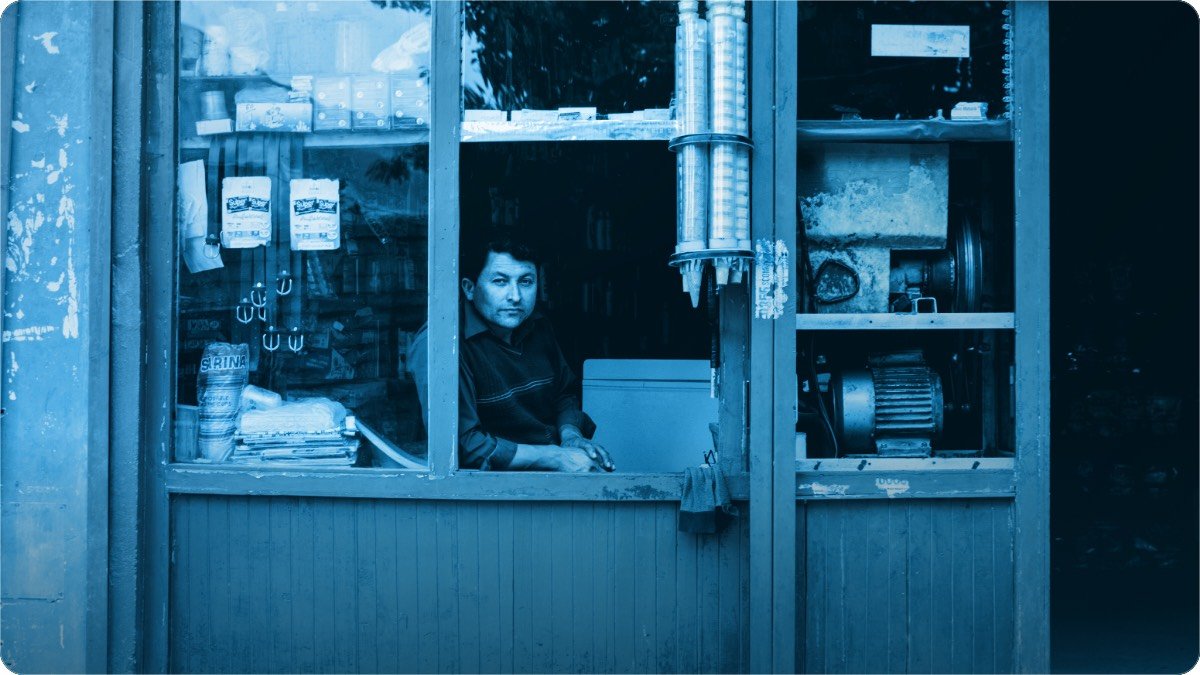
Give him a small first udhaar, not the one he asked for. A stranger's first credit is a test, not a sale, and the cheapest test is a small amount with a short date. Say yes to part of it, write it down in front of him, and let the first repayment decide everything after that.
The face you have never seen before
A man walks in at eleven in the morning. You have not seen him before. He picks up rice, oil, tea and a sack of flour, and at the counter he says he will settle at the end of the month.
The bill is Rs 6,200. He is polite. He is not in a hurry. He gives you a phone number before you ask for one.
Everything in that moment pushes you toward yes. Refusing a stranger while two other customers are listening feels rude, and there is a quiet voice saying that this is exactly how a good regular customer begins.
Sometimes it is. But shopkeepers who lose serious money to credit rarely lose it slowly to their regulars. They lose it in one afternoon, to somebody whose second name they never learned.
Why a first udhaar is a different decision
With a regular you are not guessing. You have months of behaviour behind you: how he pays, how he takes a reminder, whether he argues about a total or simply checks it.
With a new face you have four minutes of manners, which is the one thing any person can control.
So the decision is not really about him. It is about how much you are willing to spend to find out about him. A first udhaar is a fee you pay for information, and the only useful question is how large that fee should be.
Rs 500 buys the same information as Rs 6,200. Both tell you whether he comes back on the day he promised. One of them costs twelve times more when the answer turns out to be no.
Give him a piece of what he asked for
The right answer to a big first request is almost never a flat refusal. It is a smaller yes.
Say a new face asks for Rs 6,200 on credit
Look at the second half of that table. The shop that gave the full amount is not twelve times better off when the customer is good, because a good customer would have come back anyway and bought again. It is only twelve times worse off when he is not.
That is the whole shape of the thing. The upside of a large first udhaar is small and the downside is large, so you take the small version and let time buy you the rest.
In practice the smaller yes has three parts. A part of the goods on credit and the rest in cash today. A date that is days away, not weeks. And the whole thing written down while he watches you write it.
What to establish before you write the entry
None of this is an interrogation. It is four ordinary counter questions that a genuine customer answers without blinking.
Before you write the first entry for a stranger
- The name people actually call him by, plus a landmark
- A phone number, written at the counter while he stands there
- Where he lives or works, near enough to walk past your door
- The exact day he will return, said out loud and then written
- How much is credit and how much he pays in cash today
- One line naming the goods, so the entry reads on its own later
The address matters more than people expect. A customer who lives or works within a few streets of your shop has something at stake: he will walk past your door for years. A customer from an area you cannot picture has nothing at stake except one phone number he can change.
Ask where he stays in a normal voice, the way you would ask anybody. Most people answer happily. The ones who go vague have just told you something for free, and that is the answer to your question.
Write the name he actually goes by along with a landmark, not just a mobile number. Six weeks later "Nadeem" is useless in a khata with three of them, while "Nadeem, workshop near the bus stop" finds itself. This is also the difference between a name you can chase and one that vanishes, which is what usually turns into a customer who has disappeared with your udhaar.
Start your digital khata today
Free to start. Works offline. English, Roman Urdu & Hinglish. Your customers get their app free, forever.
Saying the smaller number without insulting him
The wording is what shopkeepers get wrong, not the amount. A small yes delivered badly sounds exactly like an accusation.
Do not explain your reasoning and do not talk about trust at all. The moment you say the word trust you have made the conversation about his character, and now he has to defend himself in front of your other customers.
Make it a rule of the shop instead. "For a new khata I keep it to Rs 1,500 for the first month. After that we open it up properly." That sentence blames the shop, not the man, and it has a future in it, which is the part that keeps him coming back.
Then say the date out loud and write it down. "So Rs 1,500 today and you will come on Friday." Naming the day, in front of him, does more for repayment than any amount of goodwill, and it is the same principle that separates a real promise from a customer who only ever promises.
If he pushes back hard and wants the full amount immediately, that is information too. A person who genuinely intends to pay in three weeks is rarely upset about starting smaller.
Let the first repayment do the testing
Now you stop deciding and start watching, because the first repayment tells you more than any judgement you can make at the counter.
Watch three things and nothing else. Did he come on the day, or a day or two after, or only when you called him? Did he pay the whole amount or part of it? And when he came, did he buy again?
A customer who pays on the day and buys again the same visit has earned a bigger limit, and you can raise it that afternoon. A customer who pays late but pays in full has earned a bigger limit too, just with the date written more firmly. A customer who pays part and promises the rest has told you his real capacity, and his limit is now that part, permanently.
Late one evening a shopkeeper in a busy street told a new customer that his Rs 1,500 was cleared and he could take up to Rs 4,000 now. The man bought Rs 3,000 of goods on the spot. That upgrade cost the shop nothing, and it happened because there was a number to upgrade from.
Raise limits in steps and never in one jump. Rs 1,500 becomes Rs 3,000, then Rs 6,000, over months rather than weeks, and each step is paid for by a clean repayment. Where to stop is a question of your own cash rather than his charm, and the arithmetic behind it is the same one in how much udhaar to give and to whom.
When a big first udhaar is genuinely fine
There are real exceptions, and pretending otherwise makes you look nervous rather than careful.
If somebody your family has known for years brings him in and stands behind the amount, the risk has moved onto a person you can actually reach. That is a different situation from a stranger, and it is worth being clear with the introducer about what standing behind it means, which is the honest version of asking for a guarantor.
If he pays a real part in cash today, the exposure drops immediately. Half now on a Rs 6,000 bill leaves Rs 3,000 at risk, and a man willing to put his own cash down is behaving like somebody who intends to return.
And if the goods are something you can recover or resell without loss, a larger amount is less frightening than it looks. Perishable goods are the opposite, so match the size of the first udhaar to how much of it you could ever get back.
What none of these change is the writing. Every one of them still goes into the khata with a name, a date and an amount, because the exception you remember clearly today is the entry you cannot explain in March.
Start your digital khata today
Free to start. Works offline. English, Roman Urdu & Hinglish. Your customers get their app free, forever.
Common questions
How small should a first udhaar be?
Small enough that losing it would annoy you rather than hurt you. For most small shops that is somewhere between one and two days of ordinary profit, which usually lands between Rs 500 and Rs 2,000. The exact figure matters far less than the fact that there is a figure, because a shop with no first-time limit is deciding from scratch every time somebody smiles at the counter.
He refused to give an address. Should I still sell to him on credit?
Sell to him for cash and stay friendly about it, because plenty of honest people are simply private and will happily pay today. What you should not do is give credit to somebody you have no way of reaching, since the address is not a formality but the only thing that makes a name findable later. Keep the door open and let him build a record with cash purchases first.
Is it rude to ask a new customer for his phone number?
It is completely normal, and the way to make it feel normal is to ask everybody, not only the people you doubt. Write it down at the counter in front of him as part of opening the khata, the same way a chemist or a workshop takes a number. Trouble only starts when you ask one person and not another, because then the question itself becomes a judgement.
What if a new customer asks for credit on something expensive, like an appliance?
That is a qist conversation, not an udhaar conversation, and treating it as one changes everything for the better. A written plan with a down payment, dated instalments and a guarantor is designed for exactly this, while an open credit line for a large item on a first visit is not. Take a real advance, put the schedule in writing, and give him a copy.
A new customer paid on time. How fast can I raise his limit?
Double it after the first clean repayment and double it again after the second, then slow down and let the third and fourth cycles happen at that level before you go further. Rising in steps means a customer who changes his behaviour costs you one step rather than the whole limit. It also gives him something to earn, which quietly makes people pay on time.
Should I keep a written rule for first-time credit, or decide each time?
Write the rule down and stick to it, because a rule protects you on the day your judgement is weakest, which is the day somebody very likeable asks for a lot. One line is enough: new khata starts at a fixed small amount, on a named date, with a name, a number and a landmark recorded. Deciding case by case sounds flexible and is really just deciding by mood.