
ProblemUdhaar
When a customer returns goods he took on udhaar
Goods bought on credit are coming back. Take the agreed amount off his balance instead of opening your galla, write the reason, and put the stock back.
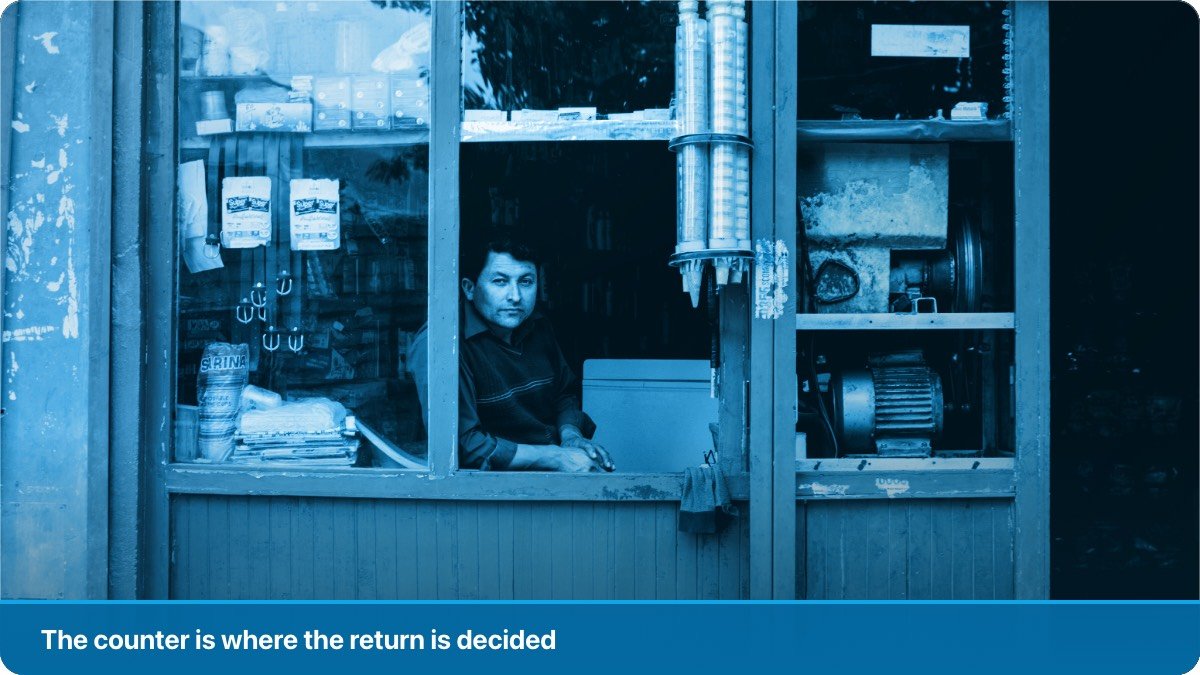
Goods that come back on a credit sale are not a refund. Nothing left your galla, so nothing should go back into his hand. Reduce his balance by what the goods are worth today, write the return the same day with the reason on it, and put the stock back into your count before you forget.
Why a return on udhaar is not a cash return
A cash return is simple. He paid Rs 900 on Tuesday, the shirt did not fit, you give Rs 900 back on Thursday and the shop is level again. Money out, goods in, done.
A credit sale never had that first half. No money came from him. The goods went out and a figure went into the khata, and that figure is the only thing that moved. So when the goods come back, the honest correction is to move the figure back down, not to open the galla.
Get that one sentence wrong and you can pay for the same item twice. The shopkeeper who hands over Rs 1,400 in cash and then forgets to reduce the balance has given away the goods and the money together, and the customer will not remind him.
There is a second difference, and it is the one that causes arguments. Cash returns come back fast, because the buyer wants his money in his pocket. A credit return can arrive three weeks later, after the item has been worn, after the season has turned, after the rate has changed. By then the thing in his hand is not the thing you sold.
Decide what you take back before anybody asks
Almost every return fight is really a fight about a rule that was never stated. He believes anything can come back. You believe nothing can, once it leaves the counter. Both of you are inventing the rule in the middle of the argument, in front of other customers, which is the worst possible moment.
Your return rule, said the same way to everybody
Comes back
- Sealed and unopened, inside a week
- Wrong size or wrong colour, unused
- A fault you can see at the counter
- Anything you would happily put back on the shelf
Does not come back
- Cut, mixed, weighed out or opened
- Food and anything that spoils
- Ordered specially on his word
- Last season's goods coming back this season
So write your own rule once, in four lines, and say it the same way to everyone. What can come back. In what condition. Within how many days. And what never comes back at all.
For most small shops the honest version is short. Sealed and unopened goods can come back within a week. Anything cut, mixed, opened or made to order cannot. Perishables cannot. Something you ordered specially for one buyer cannot, because it was never your stock, it was his.
Say it at the moment of sale for anything expensive, not on a board nobody reads. Fifteen words is enough. "If it is sealed and comes back within a week, no problem. After that I cannot take it." A customer who hears that on day one almost never argues on day ten.
Cash back or balance down
Here is the rule that keeps you safe, and it is short enough to remember at a busy counter.
If he still owes you anything at all, the return comes off the balance. Not out of the galla. He gave you no money, so there is no money of his in your shop to give back.
Say Adnan's balance is Rs 6,400 and two shirts come back
Only when his balance is already at zero does cash even become a question, and even then you are allowed to say "keep it on your side, use it next time" if that suits your cash better. Most customers accept that happily, because in a shop they visit weekly, credit on their name is as good as a note in their pocket.
The exception is the buyer who is finished with you. He is moving away, or he has cleared everything and wants nothing standing. Give him the cash, count it out in front of him, and write it as money going out so tonight's count still matches.
Start your digital khata today
Free to start. Works offline. English, Roman Urdu & Hinglish. Your customers get their app free, forever.
What the goods are worth coming back
The return price is not automatically the sale price. It is what the item is worth to your shop today, and you are the one who knows that.
Sealed, unused, still in season, still a rate you can sell at? Full price back. Anything else needs a number you decide before you write it down, and it helps to say the number out loud first: "I can put Rs 800 back on this, the packet is open." That single sentence turns a possible argument into a normal piece of business, because he can still say no and walk out with his goods.
Where shopkeepers lose money quietly is on goods that came from a plan with a fixed price. If the item was part of a qist plan, the plan was built around that item at that price, so a return has to change the plan, not just the balance. Work out the new total first, then the new instalments, then tell him both numbers in the same breath.
And never reprice a return after you have already written it. Once the figure is in the khata, it is a record, and changing it later is exactly the kind of thing that turns into an argument about who is remembering correctly. Decide, say it, write it, move on.
Write it the same day, and put the goods back in the count
A return is two entries in one, and most shops only ever make the first one.
The four minutes a return actually needs
- 1Look at the goods and say the return figure out loudBefore anything is written, while he can still say no.
- 2Reduce his balance by that figure, with the reason on it"Return, 2 shirts, sealed" answers every later question.
- 3Put the goods back into your stock count the same minuteSkip this and next month's shortage will be imaginary.
- 4Damaged goods go to the loss pile, not the shelfUnsellable stock in the record lies to you all year.
- 5Show him the new balance before he leaves the counterTwo people holding one figure never argue about it later.
The first is the money side. His balance comes down by the agreed figure, with a note saying what came back and why. "Return, 2 shirts, sealed" takes four seconds to write and answers every question anybody asks about that line in six months. In Wasoolo this is an ordinary entry against his khata, so it shows on his statement with the reason attached, and the balance you see is already corrected.
The second is the goods side, and this is the one that gets skipped. Two shirts came back into your shop. If they do not go back into your stock count, your shelf now holds more than your record says, and next month you will be hunting for a shortage that never happened. That habit is half of why stock counts stop matching in a small shop.
Damaged returns need one more decision, and it is worth making on the spot. If the item cannot be sold again, it is not stock, it is a loss. Put it aside physically, write it off, and keep it out of your shelf count. A broken thing sitting in the record as sellable goods is a lie your own numbers will tell you all year.
The customer who returns something every week
One or two names will start doing this. They buy generously, keep half, and bring the rest back on Friday like it is a lending library. Nothing they do breaks your rule, and together it is costing you real money in handling, in packets that can no longer be sold as new, and in the hour a week you spend on it.
Do not accuse anybody. Just look at the pattern first: pull his last three months of entries and see the returns beside the purchases. Usually the picture is obvious the moment it is in one column.
Then change what you offer him, not what you allow. Sell him smaller quantities. Ask him to check sizes at the counter before the goods leave. For anything expensive, take part payment at the time of sale, because a buyer who has paid something rarely returns half of it. These are all normal shop answers, and none of them require a hard word.
If it continues, the useful conversation is about the amount he carries, not about the returns. A name with a heavy running balance and a weekly return habit is telling you plainly that his side of the book is bigger than it should be, and the ceiling for that name is the thing that actually needs changing.
Start your digital khata today
Free to start. Works offline. English, Roman Urdu & Hinglish. Your customers get their app free, forever.
Common questions
He wants cash back and refuses to accept the amount coming off his balance. What do I say?
Say the true thing, plainly: "You have not paid me for these yet, so there is nothing of yours in my galla. I am taking it off what you owe, which is the same benefit to you." Then show him the balance before and after. Almost nobody argues once they can see the two figures, because the second one is smaller and it is theirs.
The goods came back after two months and I can still sell them. Do I have to take them?
You do not have to, but if they are genuinely sellable and he is a regular buyer, taking them back is usually cheaper than losing him. Just do not pretend it costs you nothing. Put back a fair figure rather than the full one, say why, and treat it as the exception it is.
What if a returned item was part of an instalment plan?
Change the plan itself, not only the balance. Take the item's price out of the plan total, work out the new remaining amount, and rebuild the instalments from there. Then tell him the new monthly figure and the new finish date on the same day, so there is one version of the plan and both of you are holding it.
My helper takes returns when I am not at the shop and I find out later. How do I stop the mess?
Do not stop him taking them, stop him deciding them. Give him one written line: sealed goods within a week come back at full price, anything else waits for you. Then have him write every return the same day with the customer's name on it, so you are reading a record in the evening instead of hearing a story.
Should I give a slip when I take a return?
Yes, for anything worth writing about. A two-line slip with the date, what came back and the new balance ends the whole class of arguments that start with "I brought that back, don't you remember". If your record is on your phone, sending him the updated statement does the same job and costs nothing.
The customer returned goods and now wants me to write off the rest of what he owes as well.
These are two separate conversations and they should not be held in one. Finish the return first: agree the figure, write it, show him the new balance. What is left after that is an ordinary balance, and it gets the ordinary treatment, which is a date and a plan he can actually manage.