
ProblemUdhaar
Asking for udhaar after a death in the family
A customer who owes you has lost someone. How long to wait, who should raise it, the words to use, and how to shrink the balance into a plan he can carry.
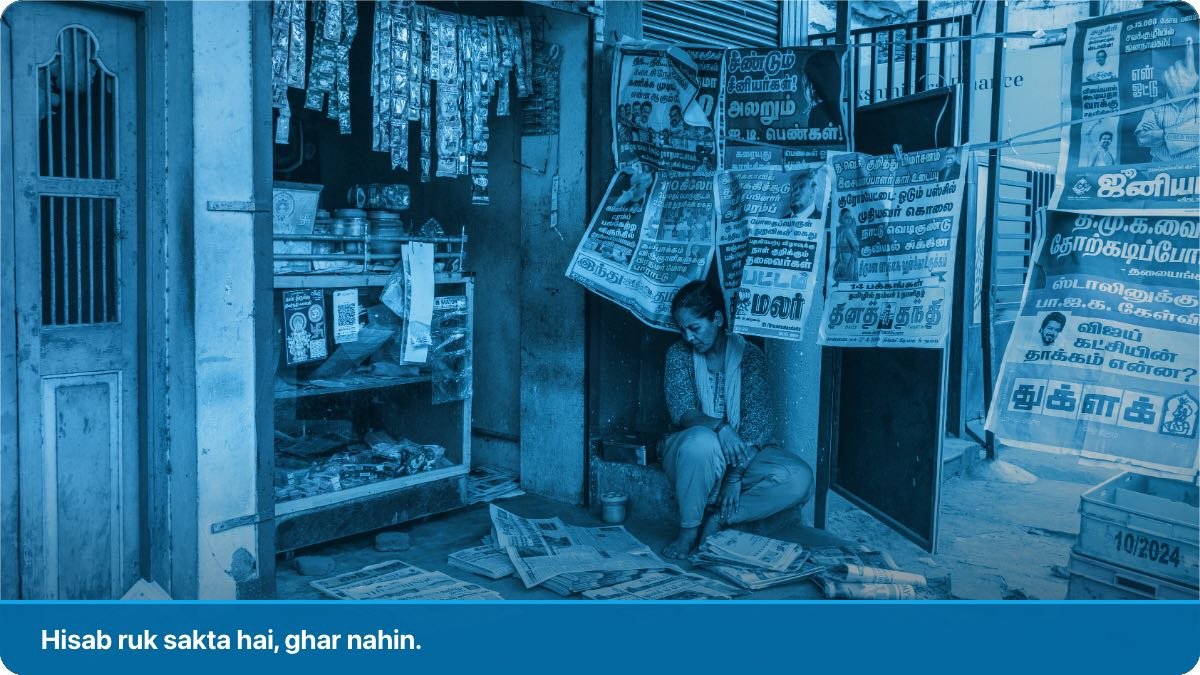
Wait, but do not disappear. Send your condolences with no mention of money, then let a few quiet weeks pass. When you do raise it, raise it in private, name a small first amount, and offer a long plan. The udhaar survives the delay. The relationship is the thing you protect first.
The khata you cannot bring up
You hear it from someone else first. A customer whose name sits in your book with a balance beside it has lost his father, or his wife, or a son. The whole street knows by the evening.
And somewhere under the sadness, a small practical thought arrives that you feel ashamed of: what happens to the Rs 14,600 he owes you.
That thought is not shameful. You gave goods out of your own stock and paid your own supplier for them. What matters is not that you thought it, but what you do for the next few weeks.
Most shopkeepers get one of two things wrong here. Some write the amount off in their heads and quietly stop serving the family, which is a cold punishment nobody discusses. Others send a message about the balance within a week and become the person the family remembers for the wrong reason.
There is a third way, and it recovers more money than either of the other two.
What the first days are for
For the first stretch after a death, your job has nothing to do with your book.
Go to the house. Sit for ten minutes. Say the ordinary things people say. If a crowd of guests has to be fed, send something from the shop and say plainly that it is not going on the account.
None of this is a strategy for getting paid, and it should not be done as one. But a shopkeeper who showed up in a bad week is one the household will not avoid afterwards, and avoidance is what kills these balances. A family that starts crossing the street to skip your door will not pay you in five years.
Keep serving them. If the widow or the son comes in for flour and cooking oil, give it and write it as you always did. Cutting a grieving household off from credit on the day it needs it most is remembered for a generation, and it converts a customer into an enemy who owes you money.
Who should raise it, and when
There is no correct number of weeks that suits every situation, so use two signs instead of a calendar.
The first sign is that the household has gone back to normal work. Someone has reopened the shop, or gone back to the job, or started collecting what other people owed the person who died. Money has started moving again in that house.
The second sign is that he raises it himself. This happens far more often than shopkeepers expect. A man who knows he owes you will say something like "I have not forgotten your account" in the middle of an unrelated conversation, and that sentence is the door opening. Walk through it gently, immediately.
Who raises it also matters. You raise it, in person, alone. Not your helper, not a message, not a relative who offers to pass on the word. A helper is heard as a demand from the shop, and a written message is read ten times in ten different moods. Your own voice, at your own counter, is the only version of this that goes well.
The words that work
The opening sentence decides the rest.
How to open the conversation, and how not to
Say something like this
- How is the household managing? Take your time with everything.
- Whenever you are ready, come and sit with me and we will sort the account out together.
- Start with whatever is easy. Rs 500 a week is fine with me.
- Keep taking what the household needs. I will keep writing it as before.
Never open with this
- I am sorry for your loss, and the balance is Rs 14,600.
- Everyone has trouble, but my own payments are due too.
- Your brother said the account would be cleared by now.
- Nothing more goes on the account until the old amount is paid.
Notice what the good column has in common. Not one of those lines starts with the amount. Each one puts the household first and leaves him room to be the one who mentions the account, which lets him keep his standing in front of you instead of being reminded of what he cannot pay.
Notice something else. The last line offers him something rather than asking for something. Telling a family that the credit is still open changes their whole reading of you, and a household that keeps buying from you keeps a live connection to your shop.
The bad column is not cruel on purpose. Every one of those lines gets said by decent people who are anxious about their own cash, which is exactly why they are worth reading twice before you go.
Make the number small before you ask
A grieving household hears Rs 14,600 as an impossible wall. The same household hears Rs 500 a week as something it can start on tomorrow. The amount has not changed. The shape has.
Say the balance is Rs 14,600 and the earner is gone
An example, not a rule. The point is the shape: cut the tail, name a small weekly figure, and never add anything to the balance for the delay.
Do three things to the balance before the conversation.
First, cut the tail. If the balance is Rs 14,600, call it Rs 14,000 and say out loud that you have dropped the rest. It costs you very little and it does something a discount rarely does: it tells the family the number is not going to grow while they are down.
Second, convert it to a weekly or monthly figure that a person in their situation can actually carry. Ask what they can manage rather than telling them, then accept the first honest answer even if it is small. A plan of Rs 500 a week that gets kept is worth more than a plan of Rs 2,000 that is broken in the second week and then avoided.
Third, write it down in front of them and give them their own copy. Not because you distrust them, but because it takes the account out of everybody's memory and puts it on a page. Households in this situation have several people making decisions, and a written plan means the son and the brother are not each guessing what was agreed.
Start your digital khata today
Free to start. Works offline. English, Roman Urdu & Hinglish. Your customers get their app free, forever.
When the person who died is the one who owed you
This is the harder version, and it needs a different approach entirely.
There is no automatic rule that the family must pay what a dead person owed, and you should not behave as if there is. Whatever the amount, going to a household and treating a son as if he signed something is the fastest way to turn a recoverable balance into a permanent loss and a story told about your shop.
So start by finding out who has stepped into that person's place. In most households one person quietly becomes the one who handles the money. That is the person you speak to, once, calmly, and only after the first weeks have passed.
Tell him what the balance is and how it was built, without any pressure attached, and offer him the paper. Many families take on the amount themselves, because standing in the neighbourhood is worth more to them than the money.
If they cannot, or will not, decide quickly and stop. A balance that a household has genuinely no way to pay is not a balance, and carrying it in your book for years does nothing but sour every future dealing you have with that family. Close it, write the reason next to it so you remember why, and treat what you learn as the price of the lesson. The same decision, and how to make it without a long argument with yourself, is worked through in the udhaar that has been sitting for a year.
What this teaches you about the rest of your book
One shock like this shows you how much of your money is sitting on single people rather than on households.
Look through your khata with that question. For each large balance, ask who else in that family knows this account exists. If the answer is nobody, that balance is one accident away from being a conversation with strangers.
The fix is not dramatic. When a big balance belongs to a household rather than to one person, note the second name and its phone number: the wife, the elder son, whoever else buys on the same account. Nothing changes in how you run the shop, and everything changes on the day something happens, because you are talking to somebody who already knows.
That habit also protects you when a customer moves away or stops answering, and it sits alongside the way limits are set out in how much udhaar to give and to whom and in keeping regular customers and still getting paid.
Records that survive an event like this are the reason many shopkeepers move their khata off paper. When each account carries a second contact, a running balance and every entry with its date, the difficult conversation is short, because nothing about the number is in dispute. Wasoolo keeps that much on a phone and sends a household its own statement without you copying anything by hand.
Start your digital khata today
Free to start. Works offline. English, Roman Urdu & Hinglish. Your customers get their app free, forever.
Common questions
How long should I wait before mentioning the balance at all?
Long enough that the household has started earning again, which is usually a few weeks rather than a few days. Watch for the practical signs instead of counting days: the business reopening, the person returning to work, or him raising the account himself. If in doubt, wait one more week, because being early costs you far more than being late.
He has not come to my shop since it happened. Should I go to him?
Go, but go for a reason that has nothing to do with money. Ask how the household is managing, tell him the account can wait, and leave without naming a figure. Many people stay away out of embarrassment about what they owe, and one visit that does not mention it removes the embarrassment and brings them back through your door.
Should I keep giving him goods on credit while the balance is unpaid?
Usually yes, with a quiet limit you set for yourself. Cutting a grieving household off is the single fastest way to lose both the customer and the money, and small ongoing purchases keep a real connection alive. Set the limit in your own head, watch it for a few months, and only tighten if the old balance is not moving at all.
What if other shopkeepers in the street are already demanding their money?
Do not join the queue, because being the tenth person shouting rarely gets you paid first. Being the only one who waited often does, since a family that recovers usually pays the person who treated it well before the ones who pushed. Keep your own record straight and stay out of it.
The son says he will pay but nothing has come for months. What now?
Move from an open promise to a written plan with dates and a small fixed amount, because open promises drift with no way to notice. Sit with him once, agree what he can genuinely manage each month, write it down and hand him a copy. If two agreed dates pass with nothing, the situation has changed from grief to avoidance and belongs with the customer who promises every time.
Can I add anything to the balance for the long delay?
No. Nothing is ever added to an udhaar balance for being late, in this situation or any other, and doing it here would be remembered by the whole street. Cut the number if anything, do not grow it. The balance you agreed is the balance you collect, however long it takes.