
ProblemShop money
When the payment comes from someone else's account
The money arrives under a name that is not on your khata. Here is how to match it to the right customer, what to write, and how to stop it happening again.
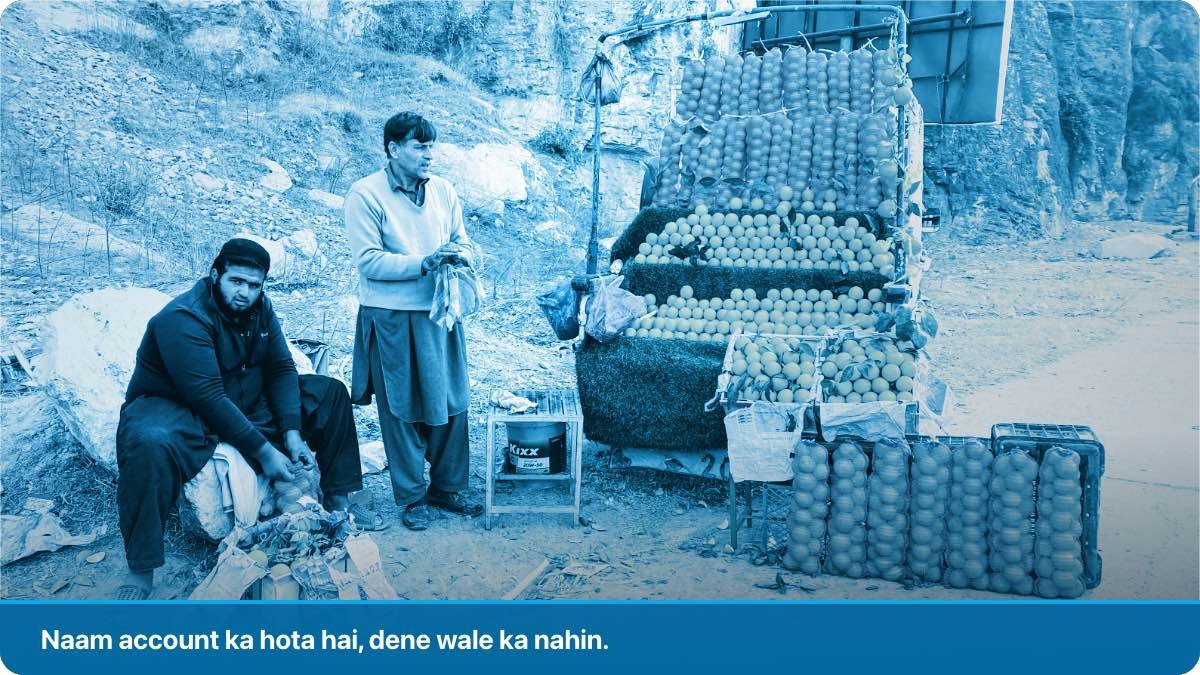
Do not guess. Match the amount against your open balances, message the sending number and ask whose payment it is, and only enter it once the customer has confirmed. Then write the sending name in the entry itself, because that name is the only way you will ever find the payment again.
The transfer with a name you do not know
The notification arrives while you are serving somebody. Rs 4,500 received. You glance at it, see a name you have never heard, and put the phone down.
An hour later you look properly. There is nobody by that name on your khata. There is no message with it, no reference, nothing.
So you do what almost everybody does. You look at your balances, find one that is roughly the right size, and decide it must be from him.
That guess is the whole problem. Four months from now, a different customer will stand at your counter and say he paid Rs 4,500 by transfer and it is not on his account, and he will be right, and you will have no way to prove where the money went.
Why it happens far more than shopkeepers expect
Once you start noticing, you find it happens most weeks, and for perfectly ordinary reasons.
Many people simply do not have an account of their own. The account belongs to a son, a brother, a wife, or a friend who set it up, and every payment that person makes leaves under somebody else's name.
Others are paying while away from home. A man working in another city sends his household's shop balance from wherever he is, using whatever account is convenient.
Some are paying on behalf of a customer altogether. A father clearing his son's balance, an employer paying for a worker, a relative settling an account as a favour.
And a few are the same person under a different name. The account was opened under a formal name that nobody in the street uses, so the transfer arrives from a stranger who is standing in front of you every day.
None of that is suspicious. It is just how money moves, and a shop that takes transfers has to have a way of handling it.
The rule: the account does not name the payer
This is the sentence worth remembering. The name on a transfer tells you which account sent the money. It does not tell you whose payment it is, and those are two different questions.
Cash never had this problem, because cash arrives attached to a person standing in front of you. A transfer arrives attached to an account, and an account can belong to anybody.
So a transfer is not a payment until somebody tells you whose it is. Until then it is money in your account with no owner, and treating it as anything else is how the trouble starts.
That distinction is also what protects you. A shopkeeper who never guesses cannot be accused of losing a payment, because every entry in his book has a named person behind it, which is the same protection described in when a customer says he already paid you.
Four steps at the moment it lands
The moment an unfamiliar name lands in your account
- 1Do not enter it anywhere yetA payment put against the wrong khata is worse than one not yet entered.
- 2Check the amount against your open balancesAn exact match to one customer's balance is usually the answer.
- 3Message the sender's number and ask whose payment it isOne line: "Rs 4,500 received, please tell me which khata it is for."
- 4Enter it only after the customer confirmsThen send him the new balance so both of you hold the same number.
The first step is the one that feels wrong and is the most important. Leaving an unmatched payment unentered for a day is safe. Putting it on the wrong khata is not, because it creates two errors at once: one customer's balance is too low, another's is too high, and neither of them will notice until much later.
The second step solves most cases by itself. Transfers are usually made for an exact balance, so an amount that matches one open account to the rupee is almost always from that customer. Treat it as a strong hint rather than as proof, and still confirm it.
The third step takes ten seconds. Message the number the money came from and ask, in one line, whose khata it is for. People answer this immediately, because the sender wants the payment credited correctly at least as much as you do.
The fourth step closes it. Once the customer confirms, enter it and send him the updated balance. That message does two jobs: it proves the money reached the right place, and it gives him a record he can check later without asking you.
Start your digital khata today
Free to start. Works offline. English, Roman Urdu & Hinglish. Your customers get their app free, forever.
What to write in the entry
The entry is where this either becomes findable or disappears.
What the entry has to say
Write it like this
- Rs 4,500 received by transfer, sent by his brother, confirmed by him.
- The date the money landed, not the date you wrote it.
- The sending name exactly as it appeared.
- Balance after this payment: Rs 3,100.
Not like this
- Online Rs 4,500.
- Payment received, name unknown.
- Adjusted against whichever balance looked right.
- Written a week later from memory.
The line everybody leaves out is the sending name. It feels unnecessary at the time, because you know exactly what happened. A year later that name is the only thread that leads back to what happened, and without it you are searching an entire year of records for an amount.
Write the date the money arrived, not the date you got around to entering it. Transfers arrive at night and get entered in the morning, and a one-day difference is enough to break a later comparison against a bank statement.
If somebody paid on behalf of somebody else, write both names. "Received from his father" is a complete record. "Received" is not.
And keep the sending name in the shape it actually appeared. Do not tidy it into the name you call the person, because the tidy version is not what you will be searching for when you go back through the account.
When two customers claim the same payment
It happens, and it is not always dishonesty. Two people can genuinely believe a payment was theirs, particularly when both sent similar amounts around the same time.
Go to the record rather than to the argument. Check the exact amount, the exact date, and the sending name. In almost every case one of those three settles it in a minute, which is precisely why the sending name is worth writing down.
If it truly cannot be resolved, look at the sending account itself and ask the person who owns it. The account holder always knows who handed him the money, and one phone call to him ends a dispute that could otherwise run for weeks.
And if it still cannot be settled, decide quickly and move on. A disputed Rs 4,500 is not worth losing two customers over. Split it, or accept it once, and fix the practice so it cannot recur. What you must not do is leave it hanging, because an unresolved payment poisons every future conversation with both of them.
Setting it up so it stops happening
Three small habits between them remove almost all of this.
Ask every credit customer for the name and number of the account he pays from, and write it on his khata beside his phone number. Most will tell you without hesitating, because they want their payments credited properly. After that, an unfamiliar name is unfamiliar only once.
Ask people to send a message with the transfer. Not a long one: their own name is enough. Say it once to each customer, and within a month a good share of them are doing it.
And check your account at a fixed time each day rather than whenever the phone buzzes. Payments that arrive during a rush get glanced at and forgotten, which is the same failure as the udhaar you forget to write down, only harder to catch, because the money is genuinely in your account and nothing looks wrong.
Keeping the account name on the customer's record is exactly the kind of small detail that decides whether your book survives contact with reality, in the same way as the precautions in if your phone is gone tonight, where is your khata. Wasoolo lets you record a payment against the right customer with a note attached to it, so the sending name travels with the entry rather than living in your memory, and the customer can be sent his updated balance in the same action.
The wider problem underneath all of this, of money arriving in two different forms and having to end up in one record, is worked through in when half your sales land in your mobile account.
Start your digital khata today
Free to start. Works offline. English, Roman Urdu & Hinglish. Your customers get their app free, forever.
Common questions
The amount matches one customer's balance exactly. Can I just enter it?
It is very likely his, and it is still worth ten seconds of confirmation before you enter it. Send one message to the number that sent the money and one to the customer you think it belongs to. If either confirms, enter it. Exact matches are usually right, but the times they are wrong are expensive and always surface months later.
Nobody answers my message about an unknown payment. What do I do with the money?
Hold it in a note of its own, with the date, amount and sending name, and do not attach it to anybody. Mention it to customers whose balances are close when they next come in, because somebody will claim it and be able to say what it was for. Money sitting unallocated is untidy; money sitting on the wrong khata is a dispute waiting to happen.
A customer says his brother sent the payment but the amount is different from his balance. Should I accept it?
Yes, and record it exactly as it is, since part payments from a third party are completely normal. Enter the amount that actually arrived, note who sent it, and send the customer the remaining balance. Never round it to the balance to make the account look tidy, because that difference is the thing you will need later.
Should I refuse transfers from accounts that are not in the customer's name?
No, because that would refuse a large number of honest payments and push people back to cash they may not have. The problem is not the arrangement, it is the missing information. Ask for the account name once, write it on the khata, and the whole issue disappears for that customer permanently.
How long should I keep these records?
Long enough to answer a question about an old balance, which in practice means at least a couple of years for any customer whose account is still running. A payment dispute nearly always concerns a payment older than a few months, so records that are cleared out annually are cleared out exactly when they become useful.
What if I already put a payment on the wrong khata months ago?
Correct both accounts, and tell both customers what you did before either of them asks. A correction you volunteer is read as honesty, and the same correction discovered by a customer is read as something else entirely. Write the reason next to the correction so the entry makes sense to anybody reading it later, including you.