
ProblemShop money
When customers pay you at home, not at the shop
Money handed over at your door, to your son or your wife, is the money that vanishes from the khata. The rule that keeps every home payment in your book.
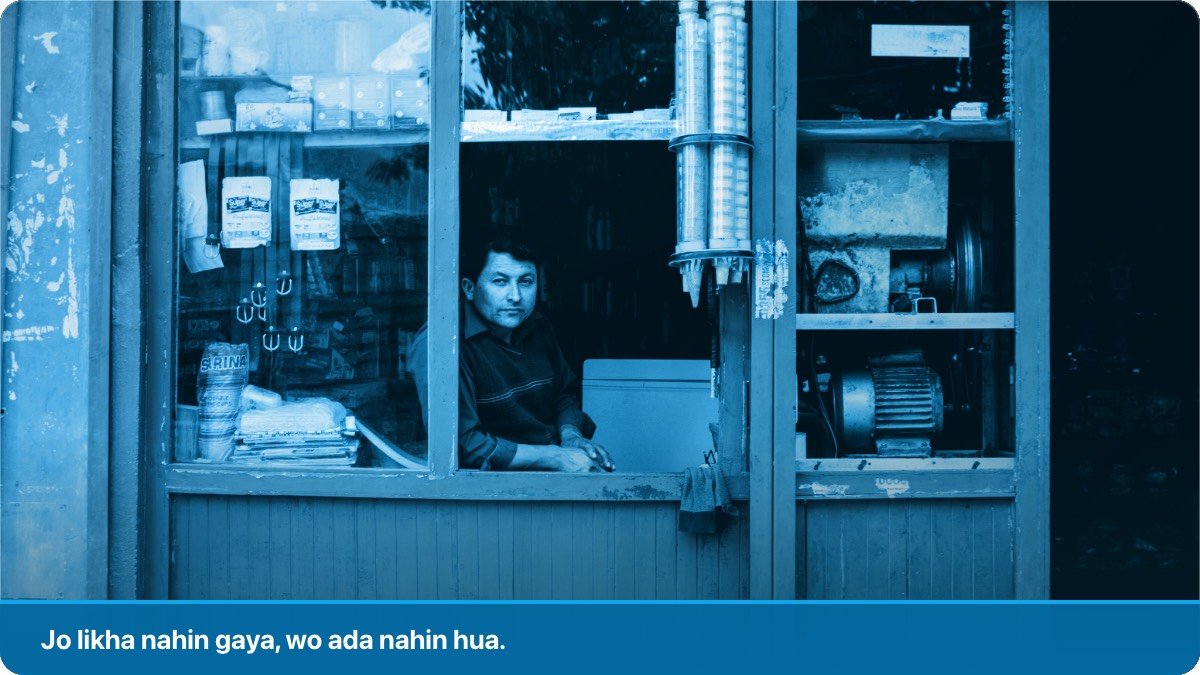
Treat it as a shop payment, not a favour. Count it in front of the person, write the name and amount before you put the notes down, send a confirmation the same day, and carry the cash to the shop, not into the house. Money handed over at your door is the money that goes missing from the khata.
The payment that never reached the shop
Rashid comes past your house at nine in the evening. He has Rs 3,000 in his pocket, he was passing anyway, and he does not want to make a separate trip to the shop. Your son opens the door, takes the notes, and puts them on the shelf inside.
Nothing wrong has happened. Everybody in that exchange is honest.
Nine days later Rashid stands at your counter, you tell him the balance is Rs 8,200, and he says he already gave you Rs 3,000. You open the book and it is not there. Now you are arguing with a customer who genuinely paid, in front of other people, and neither of you can prove anything.
That is the whole problem with home payments. They are not a small variation of a counter payment. They are a completely different event: no book, no galla, no receipt, and usually somebody in between.
Why money at the door disappears
At the counter, four things happen almost automatically. The notes go into the galla, your hand reaches for the book, the customer watches you write, and the total is right there in front of both of you.
At your front door, not one of those four is available. There is no book, because the book is at the shop. There is no galla, so the notes go on a shelf or into a pocket. There is nobody watching you write, because you are not writing.
And there is usually a gap of hours before you next open the khata, which is exactly long enough for a busy person to genuinely forget. This is the same failure described in the udhaar you forget to write down, except worse, because a missed sale costs you one entry while a missed payment costs you a customer's trust as well.
Say Rs 3,000 is handed in at your door on a busy evening
An example, not a survey. Nobody stole anything here. One unwritten line at a door turned a paying customer into an argument.
Look at what the example actually shows. Nobody stole. The notes were used for household shopping, which is normal in almost every shop-owning family, and the rest arrived at the shop days later mixed in with everything else. The money was not lost. The record was.
The rule: it is not paid until it is written
Say this to yourself once and it will save you years of arguments. A payment exists when it is written down, not when it is handed over.
The four steps for money that arrives away from the counter
- 1Count it out loud in front of the personSay the figure back to him before he leaves the door.
- 2Write it before you put it awayName, amount, date, and the words "received at home".
- 3Send him the confirmation the same dayOne message with the amount and the new balance ends every later argument.
- 4Move the notes to the shop, not into the houseCash that spends a night in a drawer at home is cash nobody can trace.
The third step is the one people skip, and it is the one that matters most. A message sent the same evening, with the amount and the new balance in it, does three separate jobs at once. It proves the payment landed. It gives the customer something to keep. And it forces you to open your records, which means the entry actually gets made.
If your khata is a paper register, that message is a photograph of the page you just wrote. If it is on a phone, sending a customer his updated balance takes a few seconds and carries the date with it, which is why so many shopkeepers stop dreading these payments once they move the book off paper.
The fourth step is worth a sentence of its own. Cash that stays in the house overnight becomes household cash by morning. It is not dishonesty, it is proximity. The notes are in the room where the household shopping money lives, and by the time you carry anything to the shop the amount has changed. The general habit behind this is set out in keeping shop money and house money apart.
Start your digital khata today
Free to start. Works offline. English, Roman Urdu & Hinglish. Your customers get their app free, forever.
When somebody else takes the money
Most of these payments are not handed to you at all. They are handed to your wife, your son, your father, or the neighbour sitting on the step outside.
That is fine, and refusing it would insult everybody involved. But the people in your house need one instruction, and it is short: take it, count it out loud, and write it on the pad by the door.
Keep a small pad and a pen at the door for exactly this. Three columns: name, amount, date. Nothing else. Anybody in the house can fill in three columns, including a child, and a scrap of paper at the door beats a perfect memory every single time.
Then make a habit of checking that pad before you leave for the shop in the morning. Anything on it gets entered properly and gets a confirmation sent to the customer. When the pad is empty, nothing happened. When it has two lines on it, you have two entries to make before you open.
If more than one person in your household regularly takes money, the risk is not theft, it is duplication and omission: two people each assuming the other wrote it. One pad, one place, one habit removes that entirely. It is the household version of the problem in why your cash box never matches your khata.
The customer who prefers paying at home
Some customers do this once by accident. Others do it every single time, and they are worth thinking about separately.
A few have an honest reason. A man who works out of town all week is genuinely only free at night. A woman who does not want to hand money over in a shop full of men will send it to your house instead, and that is a real consideration you should respect rather than argue with.
But a small number choose your door on purpose, because they have noticed that payments made there sometimes go unrecorded, and an unrecorded payment can be claimed twice. You will know which is which within two or three payments: the honest one asks for confirmation, and the other one never does.
For the honest ones, make it easy. Agree a fixed evening, keep the pad ready, and send the confirmation every time without being asked. For anybody who has already disputed one home payment, move them back to the counter politely and permanently. Say the shop keeps its accounts at the shop and you would rather write it in front of him, which is true and does not accuse anybody of anything.
Make one place where money lands
The real fix underneath all of this is smaller than it sounds. Your shop needs one place where every rupee lands, whatever door it came through.
That place is the galla and the book beside it, or the same thing on a phone. Every payment, whether it arrived at the counter, at your house, through a helper, or by transfer, ends up in the same account before the day closes.
Once that is true, home payments stop being dangerous. They are just payments that took a longer route to the same place. You can still take money at your door at ten at night, because there is a defined path from that door to the record, and the path takes under a minute.
Wasoolo works this way because the record is on your phone, and your phone is at your door as well as at your counter. You mark the payment against the customer's khata while he is still standing there, and he gets his updated balance immediately. What changes is not the amount, it is the argument that never happens nine days later.
Start your digital khata today
Free to start. Works offline. English, Roman Urdu & Hinglish. Your customers get their app free, forever.
Common questions
A customer paid at my house and I forgot to write it. He says Rs 3,000, I have nothing. What now?
Accept it, unless something specific tells you otherwise. Your record has the gap, not his, and a customer who volunteers a payment you had no note of is almost always telling the truth. Enter it with the date he gives you, send him the corrected balance, and treat the loss as the fee for learning the rule. Fighting it costs you the customer and you still cannot prove anything.
Should I just refuse to take money anywhere except the shop?
A flat refusal turns willing payers away, and willing payers are rarer than shopkeepers admit. Take the money and fix the record instead: pad at the door, confirmation the same day. Reserve the refusal for the one or two customers who have already disputed a home payment, and tell them plainly that the shop keeps its accounts at the shop.
My wife takes most of these payments. How do I make it reliable without an argument?
Give her a system, not a lecture. One pad by the door with three columns, and a habit of you checking it every morning before you leave. It takes her ten seconds and it removes the thing that actually annoys people in this situation, which is being asked later to remember exactly what happened.
The customer sent the money by transfer instead of coming. Is that safer?
Safer for proof and just as easy to lose in the record, because a transfer that lands at night still needs an entry against his name. Check the notification, match it to the customer, and enter it before you sleep. A transfer with no name attached to it in your book is the same missing line as an unwritten payment at the door.
How do I send a confirmation if I only keep a paper register?
Photograph the line you just wrote and send him the picture, which takes about as long as typing it. Include the date and the balance in the message so he can read it without deciphering your handwriting. Anything he can hold and re-read is enough to stop a dispute forming.
Is it worth doing all this for a payment of a few hundred rupees?
Yes, because the size of the payment has nothing to do with the size of the argument. A missing entry of Rs 400 produces the same standoff at the counter as a missing entry of Rs 4,000, and the habit only works if it is automatic. Small payments are also the ones most often handed over at a door, so they are exactly where the rule earns its keep.